

10 Best AI Writing Tools in 2026 (Tested for SEO, Fiction and Marketing)
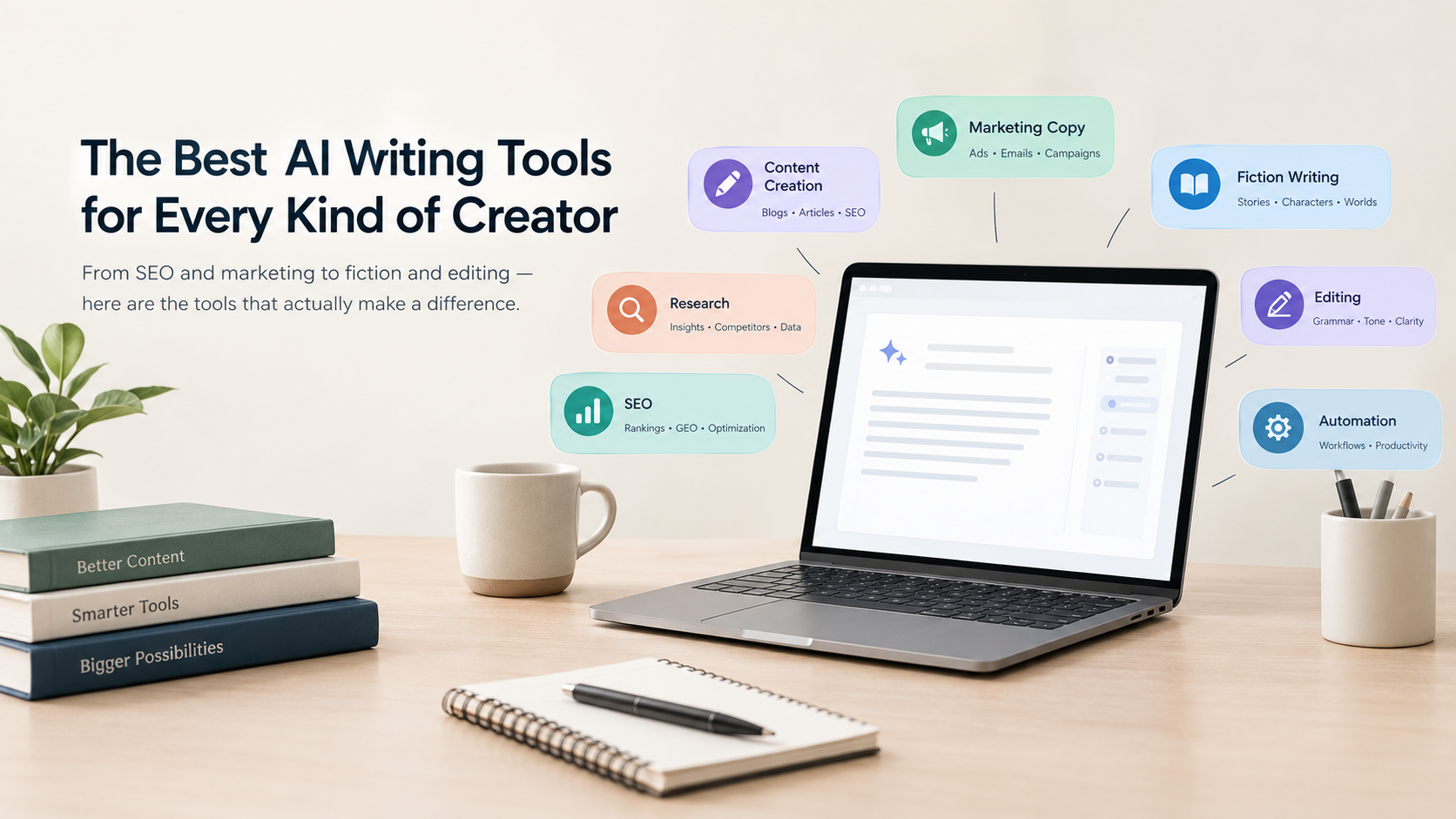
We evaluated 15+ AI writing tools across three core use cases for SEO content production, fiction drafting, and marketing copy generation plus editing and research workflows. Each tool was tested against the same criteria: output quality, workflow integration, pricing transparency, and whether it does something the raw underlying model cannot. Most "AI writing tools" are a thin interface wrapped around GPT-5.5 or Claude 4.6. The tools that survived our filter earned their place through brand-voice training, fiction-aware memory, SEO scoring, or campaign-level automation.
Quick Comparison Table
| Tool | Best For | Starting Price | Standout Feature |
|---|---|---|---|
| Jasper | On-brand marketing at scale | $69/seat/mo | Brand Voice + Slack Agent + GEO scoring |
| Surfer SEO | SEO-first content teams | $49/mo | Real-time Content Score vs. live SERP |
| Sudowrite | Fiction & novel writing | Credit-based | Story Bible + Muse fiction model |
| Frase | SEO + AI-search workflows | $49/mo | Native GEO scoring + MCP support |
| Writesonic | Combined SEO + GEO | $79/mo | Citation rate tracking across AI platforms |
| Copy.ai | GTM workflow automation | $24/mo | Multi-step autonomous content workflows |
| Anyword | Performance marketing copy | $39/mo | Predictive Performance Scores |
| Grammarly | Editing & tone | Free / $30/mo | Works everywhere + Expert Review |
| QuillBot | Paraphrasing & humanizing | Free / $19.95/mo | Best budget paraphraser |
| Rytr | Budget short-form copy | Free / $9/mo | Cheapest usable paid AI writer |
1. Jasper — Best for Marketing Teams
Best for: Marketing teams that need on-brand content at volume across multiple channels.
Jasper remains the standard for structured marketing workflows. Its Brand Voice and Knowledge Base features let teams train the AI on approved messaging, product details, and audience profiles; so output stays consistent across writers and campaigns. In 2026, Jasper added a Slack Agent that lets marketers generate first drafts directly inside campaign threads, and AI Visibility Workflows with built-in GEO scoring to help content compete in AI-native search results.
Limitation: At $69/seat/month, it's the most expensive tool on this list. The value only materializes if you're running multi-person marketing operations with brand governance needs.
2. Surfer SEO — Best for SEO Content Optimization
Best for: Content teams whose primary goal is ranking in traditional search results.
Surfer's real-time Content Score benchmarks your draft against pages currently ranking for your target keyword but the most immediate on-page optimization feedback loop in the category. In 2026, Surfer expanded into AI search monitoring, tracking whether your brand appears in Google AI Overviews, ChatGPT, and Claude responses. Its NLP-powered analysis draws from over 500 web signals across billions of live SERP data points.
Limitation: Not a complete SEO stack and no backlink analysis, rank tracking, or technical site audit. Pair it with Ahrefs or Semrush for full coverage.
3. Sudowrite — Best for Fiction Writers
Best for: Novelists and creative writers who need a tool built around narrative, not blog posts.
Sudowrite is the only tool on this list designed from the ground up for fiction. Its Story Bible tracks characters, plot points, and world details across a manuscript, solving the consistency problem that plagues general LLMs at the 30,000-word mark. The Muse model is fiction-trained and maintains author voice across 80,000-word manuscripts in ways general models cannot.
Limitation: Credit-based pricing can hit prolific writers hard, and the advantages diminish for non-fiction.
4. Frase — Best for SEO + AI-Search (GEO) Workflows
Best for: Teams that need to rank on Google and get cited by AI platforms simultaneously.
Frase rebuilt its platform in January 2026 with AI visibility architecturally equal to traditional search. Its GEO Optimization scoring system and the only native GEO scoring feature in any SEO tool which evaluates content for AI citation potential. Official MCP server support lets teams run Frase operations directly from Claude, Cursor, and other AI environments.
Limitation: Starter plan caps at 10 articles and 50 audit pages per month, which active teams will exhaust quickly.
5. Writesonic — Best for Combined SEO + GEO
Best for: Teams that want SEO and GEO in one platform without tool sprawl.
Writesonic's Content Optimization feature analyzes existing content against GEO best practices, identifying schema gaps, title-content mismatches, and missing comparison tables. The company claims citation rate increases of 60-70% when addressing its recommendations. It sources optimization prompts from 2 billion real AI conversations, ranking gaps in an Action Center.
Limitation: SEO capabilities focus on content optimization rather than the full technical SEO depth enterprise teams need.
6. Copy.ai — Best for GTM Workflow Automation
Best for: Sales and marketing operations teams that need automated content pipelines.
Copy.ai pivoted decisively into GTM workflow automation. Its multi-step autonomous sequences handle prospect research, account-based marketing content, and CRM enrichment without per-step human approval. An LLM-agnostic intelligence layer routes each workflow step to the most efficient model and OpenAI for simple tasks, Anthropic for nuanced generation.
Limitation: Content quality for long-form blogging lags behind Jasper and Writesonic. Users report output can feel robotic. The pricing gap between $24/month and enterprise is opaque.
7. Anyword — Best for Performance Marketing Copy
Best for: Performance marketers who need data-backed copy decisions.
Anyword's Predictive Performance Scores are trained on real marketing outcomes, giving every generated variation a data-backed engagement estimate. Performance marketers can choose between copy variations based on predicted conversion impact rather than subjective judgment. The platform integrates bidirectionally with Salesforce, HubSpot, Marketo, Braze, Meta, and LinkedIn.
Limitation: Performance prediction credits not copy volume are the real constraint. Starter provides 50 predictions monthly on month-to-month billing. Scoring is strongest for direct-response copy (ads, email subject lines) and weaker for blog content.
8. Grammarly — Best for Editing & Tone
Best for: Writers who need an always-on editing layer across every application.
Grammarly checks grammar, clarity, sentence structure, and tone across common workplace apps which Google Docs, Gmail, Slack, Word without requiring users to draft inside a separate platform. The 2026 release added Expert Review, which analyzes text from the perspective of known writing styles, plus AI content detection and plagiarism checks. It's now part of the broader Superhuman suite but remains a standalone editing product.
Limitation: Not a drafting tool. If you need generation from scratch, pair it with ChatGPT or Claude.
9. QuillBot — Best Budget Paraphraser
Best for: Students, bloggers, and anyone who needs to rewrite, simplify, or humanize existing text.
QuillBot scores 4.6/5 in our testing and remains the top pick for editing, rewriting, and humanizing AI-generated text. The free tier restricts paraphrasing to 125 words per input, but the premium plan at $8.33/month billed annually unlocks all modes. It's far less intrusive than Grammarly and no aggressive underlining or upsell prompts.
Limitation: Free version is severely limited. Occasional processing delays and context misreading have been reported.
10. Rytr — Best Budget AI Writer
Best for: Beginners and solo creators who need short-form copy at the lowest possible cost.
Rytr is the lowest-risk paid AI writer on the market at $9/month for unlimited generation, with a free tier offering 10,000 characters monthly. It supports 30+ languages, 20+ tones, and a browser extension that works inside Gmail, Facebook, and WordPress. It's not a long-form workhorse and output can feel formulaic for blog posts but for social captions, product descriptions, and email subject lines, it delivers exceptional value.
Limitation: Not suitable for long-form SEO content or brand-consistent marketing at scale.
Honorable Mentions
Scalenut — First platform purpose-built for GEO, with AI Visibility tracking across ChatGPT, Perplexity, and Google AI Overviews. The Cruise Mode generates full-length GEO-optimized articles in minutes. Starts at $39/month.
NeuronWriter — Best-value semantic SEO tool at $19/month, delivering Clearscope-level NLP optimization without the enterprise price tag. Wins on price and analyses per dollar against Frase.
Koala AI — KoalaWriter v2 with Brand DNA generates SEO-optimized articles with your services, voice, and credentials baked in. Automatic internal linking and real-time source citation. From $9/month.
NovelAI — A dedicated AI co-author for narrative fiction, fantasy, and immersive storytelling. Built from the ground up as a writing partner rather than a content generator.
How to Choose Best AI Tools for AI Writing
Start from what you're writing, not the tool:
-
Marketing at scale with brand governance → Jasper or Anyword
-
Ranking on Google and getting cited by AI → Surfer SEO or Frase
-
Writing a novel → Sudowrite
-
Editing and polishing everything you write → Grammarly + QuillBot
-
Budget short-form copy → Rytr
-
Technical SEO with semantic optimization → NeuronWriter
The practical takeaway: if you last tried one of these tools a year ago, re-evaluate. The differentiators in 2026 are completely different and brand memory, fiction-aware consistency, GEO scoring, and workflow automation are what separate the surviving tools from the thin GPT wrappers.
Discover Tools Mentioned in this Guide
Explore our curated database of 2,600+ artificial intelligence software and tools.
Explore AI Directory →