

ChatGPT for Marketing: The Complete 2026 Guide
A 2026 evidence-based guide to ChatGPT for marketing that leads with the 6.5% ROI measurement gap, introduces the 5PMS prompt framework, and links eight use-case clusters which is built for search rankings and AI citations, not generic coverage.
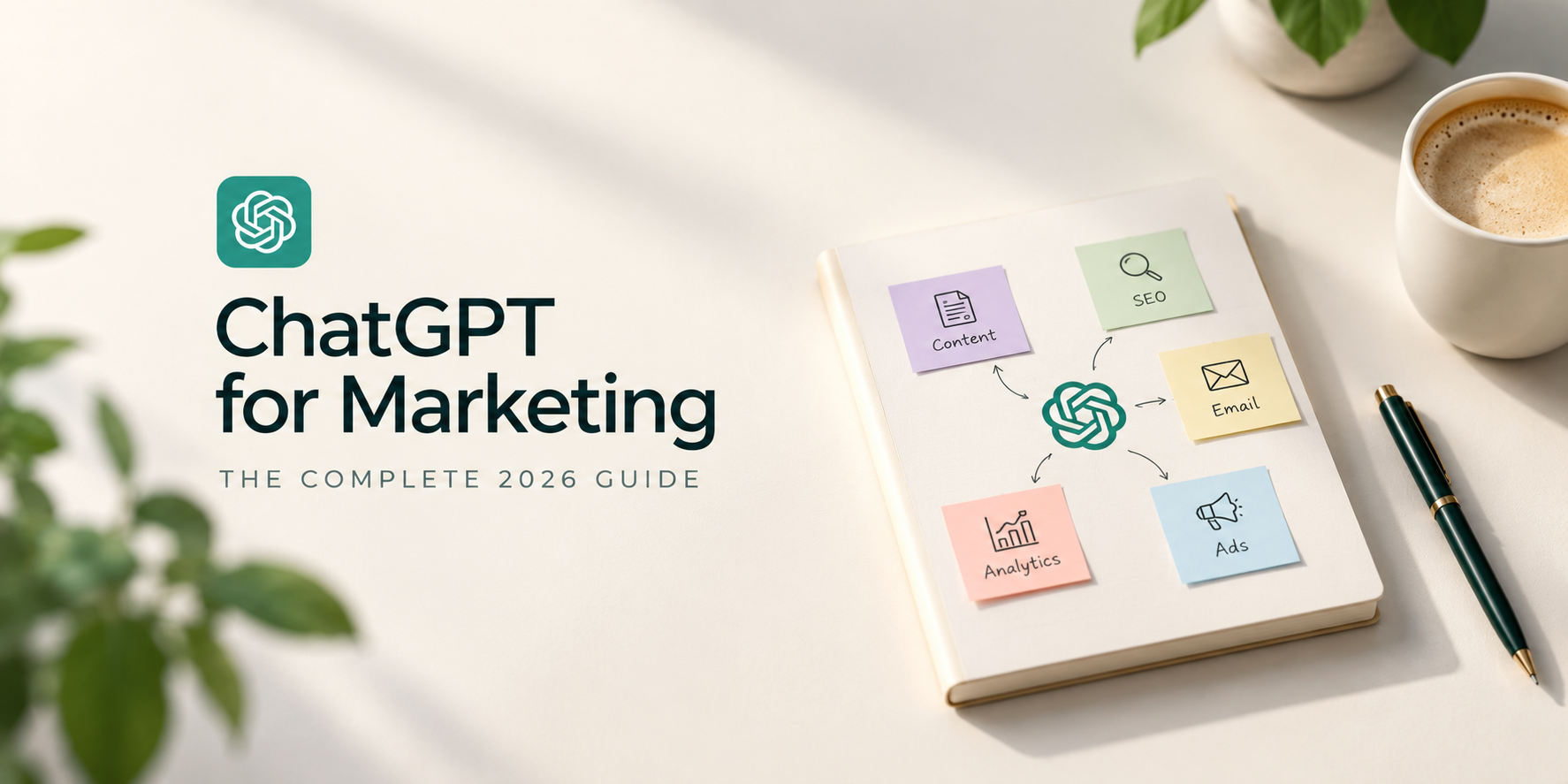
ChatGPT for marketing is a drafting and analysis layer that accelerates execution across content, SEO, email, ads, and analytics. In 2026, 74.5% of marketers use it, yet only 6.5% measure its return against benchmarks. This guide closes that gap with a workflow, evidence prompts, and a measurement model.
ChatGPT for marketing works when it is treated as a structured execution layer inside a human-led workflow not as an autonomous content machine. It is strongest at first drafts, variation generation, repurposing, and conversational analysis of data you provide. It is weakest on live data, verified facts, and distinct brand voice. The sections below show what that looks like in practice, with the evidence behind each claim.
Why Most ChatGPT Marketing Guides Fail in 2026
Most guides on this topic are structurally identical: a definition, eight use cases, a prompt dump, a comparison table, and an FAQ. That structure is not wrong, but it creates a zero information gain problem. Google's 2026 core updates explicitly reward content that adds new semantic value beyond the existing SERP; pages that restate what competitors already say see their ranking potential capped regardless of word count or polish.
The same logic applies more harshly in AI answer engines. ChatGPT, Perplexity, and Gemini do not weigh domain authority or backlinks when selecting sources — they select based on what a page contributes that others do not. A comprehensive but generic guide is invisible in that environment.
The fix is not to write longer. It is to write with evidence: original observations, first-hand workflow notes, named frameworks, and a measurement model that competitors skip. This guide is built on that principle. Every section below either supplies a framework you can use or points to the specific evidence you should collect when you run the workflow yourself.
What Is ChatGPT for Marketing?
ChatGPT is a large language model developed by OpenAI. In a marketing context, it is an execution and ideation layer: it generates text, structures arguments, produces variations, and summarizes research you provide. It is not a strategy layer. It does not have access to your analytics, your CRM, your competitive positioning, or live search results unless you explicitly supply that context.
The practical definition: ChatGPT for marketing is the use of OpenAI's chatbot to accelerate text-heavy, variation-heavy, and research-heavy marketing tasks — first drafts of content and landing pages, ad variants, email sequences, social captions, SEO briefs, and conversational analysis of campaign data.
What it is not is a replacement for marketing judgment. The data is clear on this. 47.1% of marketers encounter AI errors weekly, and 36.5% have published hallucinated content publicly. The marketers who get the most from ChatGPT treat it as a fast first-draft engine and route every output through a human fact-check and brand-voice review before publication.
The 2026 Reality: High Adoption, Low Accountability
The central tension of ChatGPT for marketing in 2026 is not whether marketers use it. It is whether they can prove it works.
Adoption is near-universal but fragmenting. According to Basis's fourth annual AI and the Future of Marketing report (n=184), 74.5% of marketing and advertising professionals use ChatGPT in their work, down from 88.6% a year earlier, while Claude rose from 17.9% to 72.3%. Social Media Examiner's 2026 report (n=681) shows a similar pattern: ChatGPT remains the most widely used platform at 81%, but Claude tripled its user base and overtook ChatGPT as marketers' "most important" platform.
Daily use has nearly doubled, but measurement has not. Basis found that 61.4% of marketers now use AI daily, up from 33.6% in 2025. Yet only 6.5% measure the return on their AI spending against defined benchmarks. Jasper's State of AI in Marketing 2026 (n=1,400) confirms the pattern: 91% of marketing teams use AI, but only 41% can demonstrate AI ROI, down from 49% the previous year.
The gap is the opportunity. The teams that build a measurement model even a simple one which have a structural advantage over the 93.5% that cannot prove what ChatGPT is returning. This guide supplies that model in the ROI section below.
What Are the 8 Core Marketing Use Cases for ChatGPT?
The eight use cases below form the working core of ChatGPT for marketing. Each section summarizes the job, the key limitation, and links to a full cluster guide. Treat these as entry points, not deep dives and the step-by-step workflows live on the cluster pages.
Social Media Content
ChatGPT is strongest on social when it is used for variation and repurposing, not for inventing a voice. It can turn a single long-form asset into platform-specific posts, generate hook variations, and adapt tone for LinkedIn versus Instagram. Output quality depends almost entirely on whether you supply a real source asset — a webinar transcript, a blog post, a customer story — rather than asking the model to invent from a topic.
The human layer matters on brand voice and factual claims. Left alone, ChatGPT produces polished, generic social copy and will confidently fabricate statistics. The workflow: feed real material, specify platform and audience, generate variants, then select and edit with human judgment.
Email Manorketing Campaigns
For email, ChatGPT's highest-value jobs are subject-line variation, sequence drafting, and segment-level personalization. It can generate 20 subject lines in a minute and draft a five-email welcome sequence from a brief. The limitation is data: it does not know your open rates, deliverability constraints, or customer behavior unless you provide that context. It also defaults to a promotional tone that can feel generic.
The strongest email workflows use ChatGPT for the drafting and variation layer, then route output through a human who knows the list, the offer, and compliance requirements.
SEO Content Briefs
ChatGPT is useful for structuring SEO briefs: grouping keywords into clusters, drafting heading outlines, generating FAQ sections, and writing meta title and description variations. It can propose a pillar-and-cluster architecture from a raw keyword list in seconds.
What it cannot do is validate search volume or see live SERP data. Any volume it suggests is a hypothesis, not a fact. Use it for the structural and linguistic parts of the brief, then validate every number in a real SEO tool before handing the brief to a writer.
Ad Copy (Google, Meta, LinkedIn)
Ad copy is ChatGPT's most mature marketing use case because the task is inherently variation-driven. A single prompt can produce ten ad variants across different angles — pain-agitate-solve, social proof, curiosity, urgency, authority which is formatted for the platform. For performance marketers, this collapses the time between "we need fresh creative" and "we have testable variants."
The risk is platform policy and claim accuracy. ChatGPT does not know Google Ads editorial rules, Meta's personal-attribute restrictions, or LinkedIn's B2B tone norms unless you tell it. It also has no access to your performance data. Use it for the variation layer; keep the media buyer in the loop for policy, targeting, and final selection.
Landing Page Copy
Landing pages require a tighter argument than blog content. ChatGPT performs best when given a clear conversion structure — problem, promise, proof, objections, CTA — and a specific audience. It can draft hero sections, benefit blocks, objection-handling sections, and CTA variations, and rewrite an existing page from a different angle for an A/B test.
The failure mode is generic persuasion. Without real customer language, proof points, and product specifics, the output reads like every other SaaS page. Feed it voice-of-customer data, a clear offer, and a structural template, then edit heavily for specificity.
Brand Voice
ChatGPT can mimic a brand voice if you provide a style guide, 3–5 representative samples, a banned-phrase list, and a clear audience definition. Projects and custom instructions in ChatGPT Plus/Team make this repeatable across sessions.
But voice is not judgment. ChatGPT drifts toward a "professional marketing" register when it runs out of specific context and flattens distinctive syntax into safer phrasing. Brand voice work is a human-in-the-loop editing discipline, not a one-time prompt. The model produces a candidate; the brand owner decides what actually sounds like the brand.
Tool Comparison: ChatGPT vs Jasper vs Copy.ai
The honest answer for most marketing teams in 2026 is that ChatGPT Plus at $20/month is the default starting point. It handles a broader range of tasks than any single dedicated writing tool. Jasper and Copy.ai earn their higher prices only when a team needs a specific capability ChatGPT does not provide out of the box: locked brand-voice controls, shared templates, campaign workflows, or seat-based collaboration at scale.
The trade-off is systemization versus flexibility. ChatGPT is a blank canvas you build on; Jasper and Copy.ai are pre-built systems you operate inside. The full comparison table and decision logic are below.
Marketing Analytics
ChatGPT's analytics use case is conversational analysis, not automated reporting. Marketers paste campaign data into the chat and ask it to identify patterns, explain anomalies, suggest hypotheses, or draft a performance summary.
The critical limitation is that ChatGPT is not a BI tool. It does not connect to your ad accounts, CRM, or analytics platform by default. It will also confidently invent context when data is ambiguous. The workflow: export a clean dataset, define columns clearly, ask specific questions, and verify every number against the source system before acting on it.
The ChatGPT Marketing Stack: A Named Framework for Repeatable Output
Most guides tell you to "write better prompts." That is not a system. This guide uses a named, repeatable framework and the Five-Part Marketing Prompt Stack (5PMS) — for every prompt in the next section. Naming and defining a framework is a direct form of information gain: it gives other writers a reason to cite you and gives AI engines a structured concept to extract.
The 5PMS:
-
Role — who the model should act as (e.g., "senior SEO content strategist")
-
Context — brand, audience, product, and source material (proprietary input)
-
Task — what to produce (the specific deliverable)
-
Format — length, structure, tone, platform constraints
-
Constraints — banned claims, phrases to avoid, approval limits
A prompt without proprietary context in the Context slot will produce generic output. That is the single most important rule in this guide.
What Are the Best ChatGPT Prompts for Marketers? (Evidence-First Starters)
You do not need 100 prompts. You need a small set of 5PMS-structured starters that you adapt with your own context. The prompts below are built for the exact jobs in the eight use cases above.
1. The content brief starter (5PMS)
Role: Senior SEO content strategist. Context: Keyword: [keyword]. Audience: [persona]. Source notes: [paste]. Task: Create a detailed brief. Format: Search intent, 5 H2s, 3 H3s under each, 5 FAQ questions, meta title (60 characters max), meta description (155 characters max), 3 internal-link suggestions. Constraints: Use only the source material provided; do not invent statistics.
2. The ad variation starter (5PMS)
Role: Performance copywriter. Context: Product: [product]. Audience: [audience]. Banned claims: [list]. Task: Write 8 ad variations. Format: Headline (40 characters) / Primary text (125 characters) / Description (30 characters). Constraints: Use these angles: pain-agitate-solve, social proof, curiosity, urgency, authority, comparison, objection-handling, benefit-led.
3. The email sequence starter (5PMS)
Role: Lifecycle email strategist. Context: Audience just [action]. Goal: [conversion goal]. Customer language: [paste]. Task: Write a 5-email welcome sequence. Format: Subject (under 50 characters), preview text (under 90 characters), body (100–150 words), one CTA per email. Constraints: Tone: [tone]; no promotional language in email 1.
4. The landing page section starter (5PMS)
Role: Conversion copywriter. Context: Product: [product]. Audience: [persona]. Primary pain: [pain]. Primary promise: [promise]. Proof document: [paste]. Task: Rewrite the hero section. Format: 3 headline options, 3 subhead options, 3 CTA button options. Constraints: No jargon, no superlatives without proof, no claims outside the proof document.
5. The analytics summary starter (5PMS)
Role: Marketing analyst. Context: CSV of [campaign data] with columns: [columns]. Task: Summarize top 3 insights, 2 anomalies, 3 hypotheses for next month. Format: For every number cited, reference the column and row. Constraints: Do not invent data outside this file.
6. The brand-voice rewrite starter (5PMS)
Role: Brand editor. Context: Voice samples: [paste 3]. Banned phrases: [list]. Audience: [persona]. Draft: [paste]. Task: Rewrite the draft to match the voice. Format: Keep meaning and structure; flag any sentence with uncertain factual accuracy. Constraints: Do not add new claims.
7. The competitor teardown starter (5PMS)
Role: Competitive strategist. Context: Competitor landing pages: [paste or describe]. Task: For each, analyze positioning, primary promise, proof type, objection handling, and CTA strategy. Format: Then identify one messaging gap we can own. Constraints: Do not invent features or claims not visible in the source.
How Do You Build a ChatGPT Marketing Workflow?
A ChatGPT marketing workflow is not a prompt library. It is a repeatable system with four layers: context, templates, review, and measurement. Teams that skip the system get generic output and inconsistent quality; teams that build it get speed without sacrificing brand or accuracy.
Step 1 — Define brand voice and audience context
Create a context document every prompt can reference: brand tone and banned phrases, 3–5 representative writing samples, audience pains and language, product differentiators, and approved versus off-limits claims. Without it, ChatGPT defaults to a generic professional voice. This document becomes the foundation for custom instructions, project context, or a reusable "context block."
Step 2 — Build reusable prompt templates
Use the 5PMS from the previous section. Build a small library of templates for your recurring jobs — blog outline, ad variants, email sequence, landing page section, analytics summary — rather than reinventing the prompt every time. The difference between amateur and professional use is prompt architecture, not model choice.
Step 3 — Add a human review and fact-checking layer
This is non-negotiable. 47.1% of marketers encounter AI errors weekly, and the most common problems are brand-unsafe content (53.9%), hallucinated information (43.5%), and formatting glitches (42.5%). The review layer should include: a fact-check of every statistic and claim; a brand-voice pass; a platform-policy check for ads and email; and a final read for generic language. The goal is not to rewrite everything — it is to catch the specific failure modes ChatGPT is known to produce.
Step 4 — Measure output quality and time savings
Most teams stop at "it feels faster." Define a baseline before scaling: time per asset, revision rounds, and a 1–5 quality score (voice fit, factual accuracy, structural coherence, edit effort). Then track the same metrics after integration. The Basis data shows only 6.5% measure AI ROI against benchmarks — the teams that do have a competitive advantage in knowing where ChatGPT pays off.
ChatGPT vs Jasper vs Copy.ai for Marketing: Which Should You Use?
The right tool depends on your bottleneck: flexibility and cost, brand-voice systemization, or high-volume short-form execution. The table below compares the three on the dimensions that matter most for marketing teams.
| Dimension | ChatGPT (Plus / Team) | Jasper | Copy.ai |
|---|---|---|---|
| Starting price (2026) | $20/mo (Plus); $25/seat/mo (Team) | ~$39–$49/mo (annual); Pro ~$59–$69/mo | ~$24–$29/mo (multi-seat plans) |
| Best for | Individuals, founders, small teams that want maximum flexibility and value | Marketing teams that need locked brand voice, templates, and collaboration at scale | High-volume short-form copy, GTM workflows, and pre-built templates |
| Brand-voice control | Manual: you build voice with prompts, samples, and custom instructions | Built-in brand voice and style controls across team seats | Templates and workflows, with less emphasis on locked voice |
| Output flexibility | Broadest: text, analysis, image generation (GPT-4o), data interpretation, code | Focused on marketing copy and campaign assets | Focused on sales/marketing short-form and GTM sequences |
| Key limitation | Blank canvas: no built-in templates; requires a prompt system | Higher price for solo users; less flexible outside marketing copy | Less suited to long-form, SEO-driven content or deep analysis |
| Verdict for most marketers | Default starting point; build your own system on top | Upgrade when brand-voice consistency across many people is the bottleneck | Alternative for high-volume short-form and sales-assisted copy |
Affiliate disclosure: Some links in this section may be affiliate links. If you purchase through them, we may earn a commission at no extra cost to you. This does not influence our recommendations, which are based on the pricing and capability data above.
Important monetization note: OpenAI does not have a public affiliate program for ChatGPT itself. Affiliate revenue in this niche comes from the surrounding tools — Jasper, Copy.ai, Writesonic (30% recurring lifetime), CustomGPT (up to 20% recurring for two years), and similar platforms. The comparison and recommendation layer is where the commercial value sits; the how-to clusters build the trust that makes the recommendation credible.
What Are the Risks and Limitations of ChatGPT for Marketing?
The risks are measurable and manageable — if you build the review layer.
Hallucinations. NP Digital's 2026 study (n=565, 600-prompt test) found 47.1% of marketers encounter AI errors weekly and 36.5% have published hallucinated content. ChatGPT had the highest fully correct response rate at 59.7%, with an incorrect rate of 7.6%. Even the best-performing model is wrong often enough that every factual claim must be verified.
Generic output. Left alone, ChatGPT defaults to a polished, middle-of-the-road professional voice. The fix is context: proprietary source material, specific audience language, and a strong editing pass.
No live data or first-party access. ChatGPT does not know your analytics, ad performance, CRM, or today's search results unless you provide them. Any data-dependent task requires you to supply the data and verify the output.
Governance and data privacy. ProGEO.ai's 2026 survey (n=112) found 75.9% of marketers use generative AI daily, but only 43.8% of organizations enforce usage policies with technical controls. Using personal ChatGPT accounts for work creates "shadow AI" risk. Use team-tier plans with data controls and avoid pasting sensitive customer or campaign data into consumer tools.
How Do You Measure ChatGPT's ROI in Marketing?
ROI for ChatGPT is not a single number. It is a four-layer model that connects time, quality, cost, and revenue. The measurement gap is the defining problem of 2026: only 6.5% of marketers measure AI ROI against benchmarks, and only 41% can demonstrate AI ROI at all.
Layer 1 — Time saved per task. Measure the baseline time for a recurring task (first draft of a blog post, 10 ad variants, a 5-email sequence) before and after ChatGPT. Use your own baseline, not an industry average.
Layer 2 — Output quality score. Use a 1–5 rubric for brand-voice fit, factual accuracy, structural coherence, and edit effort required. Track average score and revision rounds per asset. The goal is fewer human hours to publishable quality — not a "perfect first draft."
Layer 3 — Cost per asset. Calculate the fully loaded cost of producing an asset (tool subscription + human hours + revision cycles) before and after ChatGPT. ChatGPT Plus at $20/month is cheap; the real cost is human review time. If review time does not decrease as output quality improves, the ROI case weakens.
Layer 4 — Revenue proxies (with caveats). Connecting ChatGPT directly to revenue is difficult because the tool sits upstream of conversion. Measure downstream proxies: content velocity, number of testable ad variants, time-to-publish for campaign assets, and the conversion rate of assets produced with versus without ChatGPT assistance. Be transparent about attribution limits most "ROI" claims in the market are not backed by a defined methodology.
Key Takeaways
-
ChatGPT for marketing is an execution layer, not a strategy replacement. Use it for first drafts, variations, repurposing, and conversational analysis; keep humans on strategy, facts, and brand judgment.
-
Adoption is near-universal, but measurement is the gap. 74.5% of marketers use ChatGPT, but only 6.5% measure AI ROI against defined benchmarks.
-
Information gain decides visibility in 2026. Generic, comprehensive guides are capped in Google and invisible in AI answer engines. Evidence — original data, first-hand notes, named frameworks — is the differentiator.
-
The 5PMS prompt architecture is the skill. Role + context + task + format + constraints produces usable output; generic prompts produce generic drafts.
-
Human review is non-negotiable. 47.1% of marketers encounter AI errors weekly. Fact-check every claim, enforce brand voice, and use team-tier tools with data controls.
-
ChatGPT Plus at $20/month is the default starting point. Jasper and Copy.ai earn their higher prices only when brand-voice systemization or high-volume short-form execution is the specific bottleneck.
Conclusion
ChatGPT for marketing works best when it is treated as a structured execution layer inside a human-led workflow — not as a magic content button. The marketers who win with it in 2026 are the ones who build context documents, reusable 5PMS prompt templates, a fact-checking layer, and a simple four-layer ROI model. They use ChatGPT to collapse the distance between idea and first draft, then apply the judgment AI cannot replicate: customer insight, brand voice, factual accuracy, and strategic prioritization.
Start with the use case where your team spends the most repetitive time — social, email, SEO briefs, ads, landing pages, brand voice, or analytics and build the workflow there first. Use the cluster guide for that use case to go deep, then expand.
Discover Tools Mentioned in this Guide
Explore our curated database of 2,600+ verified artificial intelligence software, benchmarks, and honest user reviews.
Related Guides & Articles
ChatGPT for Brand Voice: Can It Sound Like You?
ChatGPT for brand voice works when you stop asking it to be your brand and start giving it the constraints, examples, and behavioral rules it needs to match your brand. The model is a voice-matching engine, not a brand guardian.

Best AI Tools for Real Estate Agents in 2026: Listings, Leads and Follow-Up
The best AI stack for most real estate agents in 2026 is ChatGPT Plus ($20/mo) for listing copy and emails**, **Canva (free–$15/mo) for marketing visuals, and Follow Up Boss ($69/user/mo) for CRM-driven follow-up**. Agents who buy leads should add **Structurely ($179+/mo) for 24/7 qualification. Teams farming for sellers should evaluate SmartZip for predictive prospecting. That’s the short version. The rest of this guide explains why those tools made the cut, where the cheaper and more expensive alternatives fit, and how to avoid the most common AI mistake agents make in 2026: stacking tools that do the same job while leaving the real bottleneck untouched.
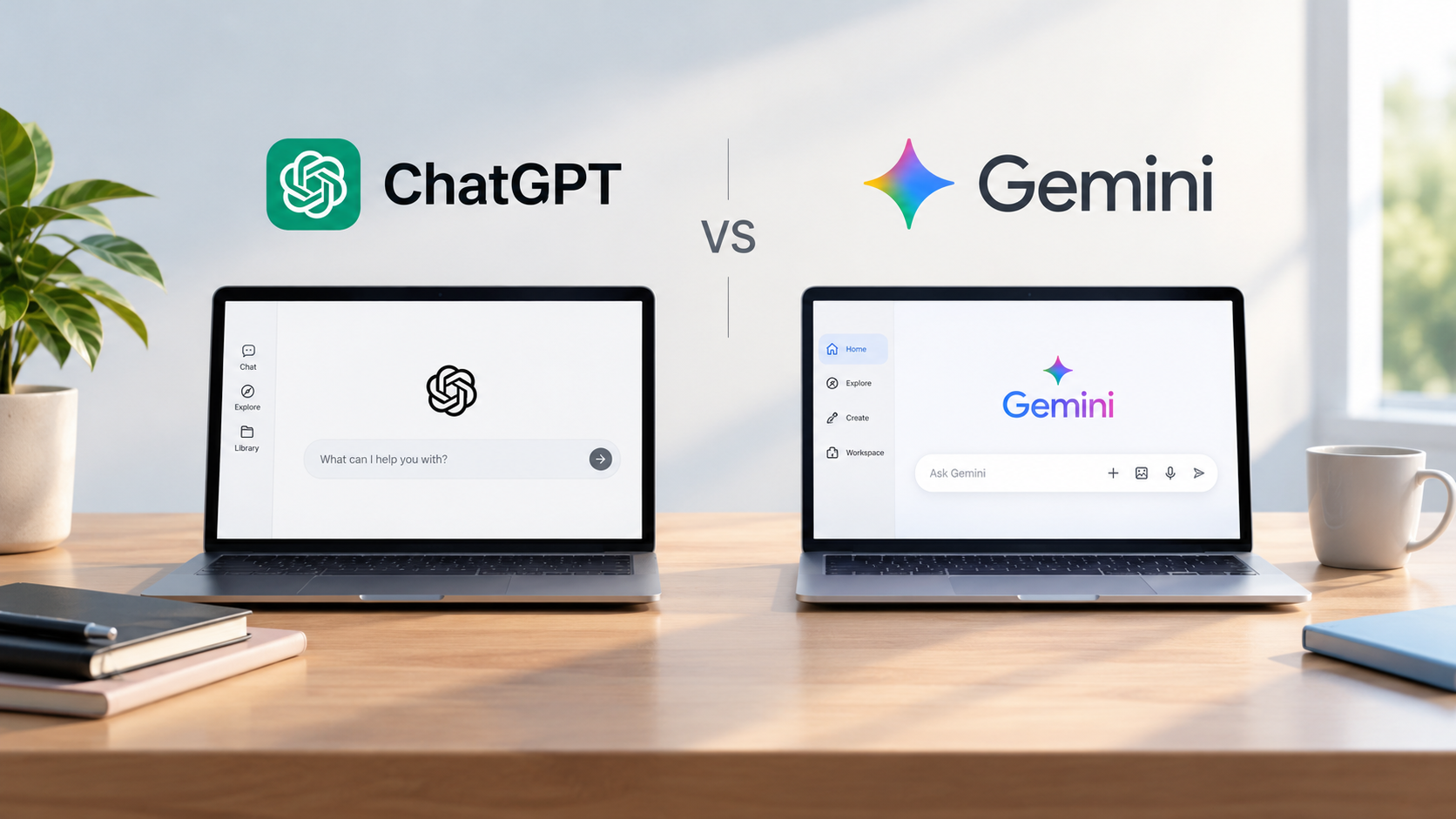
Google Gemini vs ChatGPT: Which AI Assistant Should You Actually Use?
Neither Gemini nor ChatGPT is universally "better." ChatGPT wins on reasoning, coding, and product polish but it's the stronger default for deep work. Gemini wins on price ($4.99 entry vs $8), massive context (up to 2M tokens), native video/audio input, and deep Google Workspace integration. Note two October 2026 changes: Gemini's free tier is now limited to Flash-Lite, while ChatGPT Free still trains on your chats by default and shows ads.