

15 Jobs AI Could Replace by 2030 (And 10 That May Become More Valuable)
By 2030, AI is most likely to replace routine, screen-based work: data entry, transcription, basic customer support and first-pass legal research. Skilled trades, bedside healthcare, cybersecurity and trust-based roles are far safer. The World Economic Forum still projects a net gain of 78 million jobs worldwide.
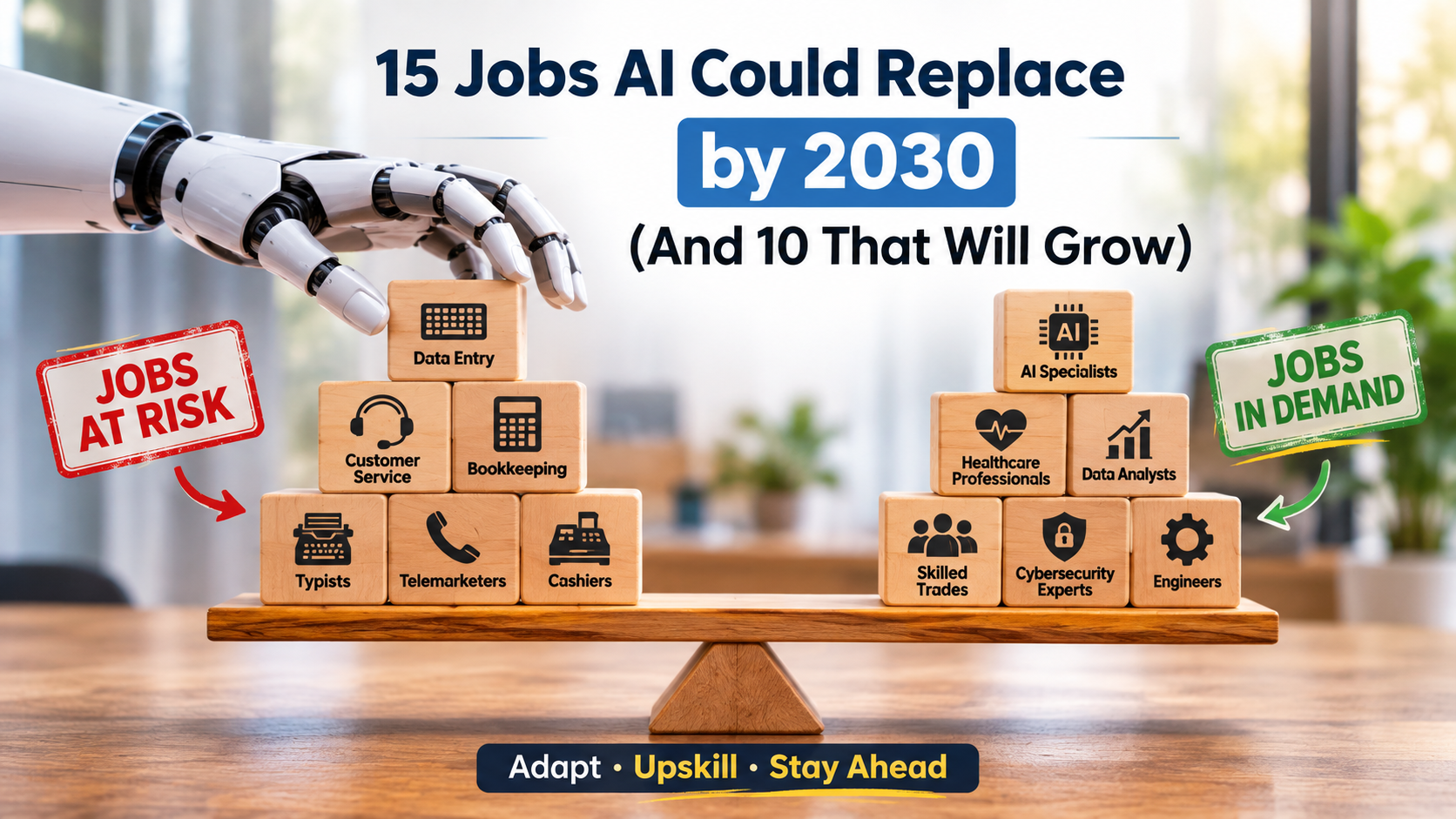
The jobs AI could replace by 2030 have one thing in common: they are built from routine, rule-based tasks done on a screen. That is exactly what today's AI tools do best. The jobs set to grow need hands-on skill, human trust or legal accountability. Below are 15 roles under pressure, 10 that are gaining value, and a plan to land on the right side of the split. If you want to see which tools are doing the work, browse our AI tools directory.
Key takeaways
- Tasks go first, not whole jobs. The IMF estimates AI could touch about 40% of jobs worldwide, but touching a job is not the same as removing it.
- The net picture is positive. The World Economic Forum expects 170 million new roles and 92 million displaced by 2030, a net gain of 78 million.
- Entry-level office work is most exposed. Early-career workers in AI-exposed jobs are already seeing weaker hiring.
- AI skills pay. PwC's 2026 AI Jobs Barometer puts the average wage premium for AI skills at 62%.
- Hands-on and high-trust jobs are safer. Electricians, nurses and cybersecurity analysts all have strong growth outlooks.
Will AI really replace jobs by 2030?
Partly, yes, but not in the way headlines suggest. AI is already cited in real layoffs, yet most forecasts still show more jobs created than lost. The gap between those two facts is where your career decisions live.
|
Source |
What it found |
Link |
|---|---|---|
|
World Economic Forum, Future of Jobs 2025 |
170M jobs created, 92M displaced, net +78M by 2030; 39% of core skills change |
|
|
IMF |
About 40% of global jobs exposed to AI; around 60% in advanced economies |
|
|
Goldman Sachs |
Generative AI could expose the equivalent of 300M full-time jobs and lift global GDP by 7% over a decade |
|
|
PwC AI Jobs Barometer 2026 |
AI-skill job postings grew 69% vs 9% for all jobs; wage premium 62%, up from 57% |
|
|
Challenger, Gray & Christmas |
101,743 US job cuts citing AI through June 2026, vs 54,836 in all of 2025 |
What is the difference between AI exposure and AI replacement?
Exposure means AI can do some of a job's tasks. Replacement means a job no longer exists. Most roles are bundles of tasks, so AI usually removes the routine ones first.
Take a financial analyst. Data pulls, ratio calculations and first-draft reports are exposed. Client advice, risk judgment and negotiation are not. The title survives; the day changes.
Older forecasts missed this. The famous 2013 Oxford study predicted 47% of US jobs were at high risk, and those predictions did not play out as feared, because real businesses face cost, regulation and accountability limits.
Is AI already causing layoffs?
Yes, in specific places. Challenger, Gray & Christmas reports AI led all stated reasons for US job cuts from March through July 2026, mostly in tech. Employers citing AI does not prove AI did the work, though. Many cuts are bets on what AI will do later, not proof of what it does today.
Why are entry-level jobs hit first?
Junior roles are full of routine tasks, which are the easiest to automate. Stanford Digital Economy Lab researchers found employment for workers aged 22 to 25 in the most AI-exposed occupations fell roughly 13% relative to less-exposed fields (Stanford Digital Economy Lab). That is the early warning sign for everyone else.
Which 15 jobs could AI replace by 2030?
"Could replace" does not mean "will vanish." It means AI can already do most of a role's core tasks, or employers are already cutting back. Official BLS projections run to 2033, so treat the 2030 view as directional.
1. Data entry keyers
BLS projects employment for data entry keyers to fall about 25% from 2023 to 2033, one of the steepest drops in the office category (BLS). AI document capture now reads invoices and forms directly.
What stays human: checking exceptions and fixing bad data.
2. Typists and word processors
This role tops BLS's list of fastest-declining jobs, at about 38% from 2023 to 2033 (BLS). Voice-to-text and AI drafting handle most of the work.
What stays human: editing for tone, accuracy and audience.
3. Telemarketers
BLS projects telemarketer employment to drop about 21.5% over the same decade. AI voice agents can now place and handle routine outbound calls at scale.
What stays human: complex, high-trust sales conversations.
4. Customer service representatives
Klarna reported that its AI assistant handled two-thirds of customer chats in its first month, work equal to about 700 agents (Klarna). Routine order and billing questions go first. See the AI customer support tools doing this work.
What stays human: angry, emotional or unusual cases.
5. Cashiers
BLS projects cashier employment to fall about 10.6% by 2033, the largest absolute drop of any occupation. Self-checkout and automated ordering do the rest.
What stays human: age checks, exceptions and service recovery.
6. Medical transcriptionists
AI speech recognition and ambient scribes now turn doctor-patient conversations into notes. BLS projects continued decline for the role.
What stays human: reviewing notes for clinical accuracy.
7. Paralegals and legal assistants (document review)
Legal AI can review contracts and discovery documents in hours, not weeks. The risk is highest for junior staff whose first-year work was exactly this.
What stays human: legal judgment, client contact and accountability to the court.
8. Bookkeeping and payroll clerks
Accounting software with AI categorisation and reconciliation shrinks routine ledger work. BLS projects declining employment for these clerks.
What stays human: advisory work, audits and judgment calls on messy records.
9. Entry-level copywriters and content writers
A Harvard and Imperial College London study of freelance platforms found demand for writing gigs fell roughly 30% after ChatGPT launched (SSRN paper). Generic blog and product copy is the most exposed. Our guide to AI writing tools shows how writers are adapting.
What stays human: original reporting, brand voice and strategy.
10. Junior graphic designers (stock and social assets)
The same study found image-related freelance demand fell about 17%. AI image generators now produce routine banners and social graphics in seconds.
What stays human: art direction, brand systems and taste.
11. Routine coding and web-development freelancers
Software-development freelance demand fell about 21% in that study. AI coding assistants now write boilerplate and simple sites.
What stays human: system design, security and code review.
12. Manual software testers
Automated test suites and AI test generation cover the repetitive checks that manual QA once did.
What stays human: exploratory testing and judging real user experience.
13. Junior data and market research analysts
AI tools now pull, clean and summarise data and draft first-pass reports. Browse our AI research tools for examples.
What stays human: choosing the right question and explaining what the numbers mean.
14. Middle managers focused on status reporting
Gartner has predicted that by 2026, 20% of organisations will use AI to flatten their structures, cutting more than half of current middle-management positions.
What stays human: coaching, conflict resolution and decisions with people consequences.
15. Drive-thru and phone order takers
Voice AI can take and confirm orders around the clock. Fast-food chains have been testing it widely.
What stays human: food prep, quality and handling the rush.
Which 10 jobs may become more valuable because of AI?
Which 10 jobs may become more valuable because of AI?
The safest jobs sit behind one of three walls: physical presence, legal accountability, or the need for human trust. A second group grows because AI itself needs people to build, secure and power it.
|
# |
Role |
Why AI struggles to replace it |
Outlook |
|---|---|---|---|
|
1 |
Electricians and power-line installers |
Varied physical sites, state licensing |
BLS: about 11% growth, 2023 to 2033 |
|
2 |
Plumbers and HVAC technicians |
Hands-on repairs in unpredictable homes |
Steady demand; see the BLS profile |
|
3 |
Registered nurses and nurse practitioners |
Bedside care, clinical judgment, patient trust |
BLS: nurse practitioners about 45% growth |
|
4 |
Physical therapists |
Hands-on treatment and patient motivation |
BLS: about 14% growth |
|
5 |
Information security analysts |
Attackers adapt; liability stays with people |
BLS: about 33% growth |
|
6 |
AI/ML engineers and data scientists |
Someone must build, test and fix the models |
BLS: data scientists about 36% growth |
|
7 |
AI governance, risk and compliance specialists |
Regulation needs an accountable human |
Emerging role; no single official figure yet |
|
8 |
Robotics and automation technicians |
Machines need installing, tuning and repair |
Rising with automation spending; no single official figure |
|
9 |
Data center and power-systems engineers |
AI runs on power and cooling |
Rising with AI infrastructure build-out; no single official figure |
|
10 |
Licensed civil and structural engineers |
A licensed person holds legal responsibility for designs |
Demand tied to infrastructure; liability rules stay human |
Why do these jobs hold their value?
Three reasons repeat across the list.
- Physical presence. AI cannot rewire a house or turn a patient.
- Accountability. When something fails, a licensed human answers for it.
- Trust. Patients, clients and regulators want a person in the loop.
Does knowing AI tools really raise pay?
Yes, on average. PwC's 2026 AI Jobs Barometer found postings that require AI skills offer a 62% higher average wage than comparable postings without them. The gap ranges from 16% in government to 118% in consumer markets.
One caution: PwC compares advertised pay between job postings. It does not promise your own raise after a course. The practical lesson is to pair AI fluency with a real domain skill. Our AI productivity tools are a low-cost place to start practising.
How can you future-proof your career against AI?
Imagine a junior analyst who spends 20 hours a week building reports by hand. An AI tool can now draft most of them. She can fight that, or she can become the person who checks the output, asks better questions and presents the findings. The second path is the one employers are paying for. The World Economic Forum expects 39% of core skills to change by 2030, so the move is to start now (WEF).
- Audit your tasks. List what you do in a normal week. Mark each task as routine (repeatable, rule-based, on a screen) or judgment-heavy (people, trade-offs, accountability). Routine tasks are the ones to automate or hand to AI.
- Learn the tools on real work. Pick two AI tools that fit your field and use them on live tasks for 30 days. Our AI tools directory lets you filter by job type and budget.
- Build the human edge. Practise negotiation, clear writing, coaching and decision-making under uncertainty. PwC's 2026 research points to judgment, creativity and leadership as the skills that set people apart.
- Move toward growth areas. Look at the 10 roles above. You do not need to switch careers; adding data, security, compliance or automation skills to your current role can be enough.
Conclusion: the jobs AI could replace by 2030 are tasks first
The jobs AI could replace by 2030 are mostly routine, screen-based roles, and the early signs are already visible in entry-level hiring. But the same forecasts show more jobs created than lost, and a growing pay premium for people who pair AI skills with real expertise.
Your move this week is simple: audit your tasks, pick one AI tool and try it on real work. Ready to start? Browse the AI Tools Zone directory to find tools for your role.
Discover Tools Mentioned in this Guide
Explore our curated database of 2,600+ verified artificial intelligence software, benchmarks, and honest user reviews.