

Where to Find AI Tools Without Spam (and How to Tell a Directory Is Lying to You)
Most AI directories are selling placement, not truth. Learn the 60-second audit that exposes fake ratings, paid badges, and dead listings and where to find AI tools people actually trust.
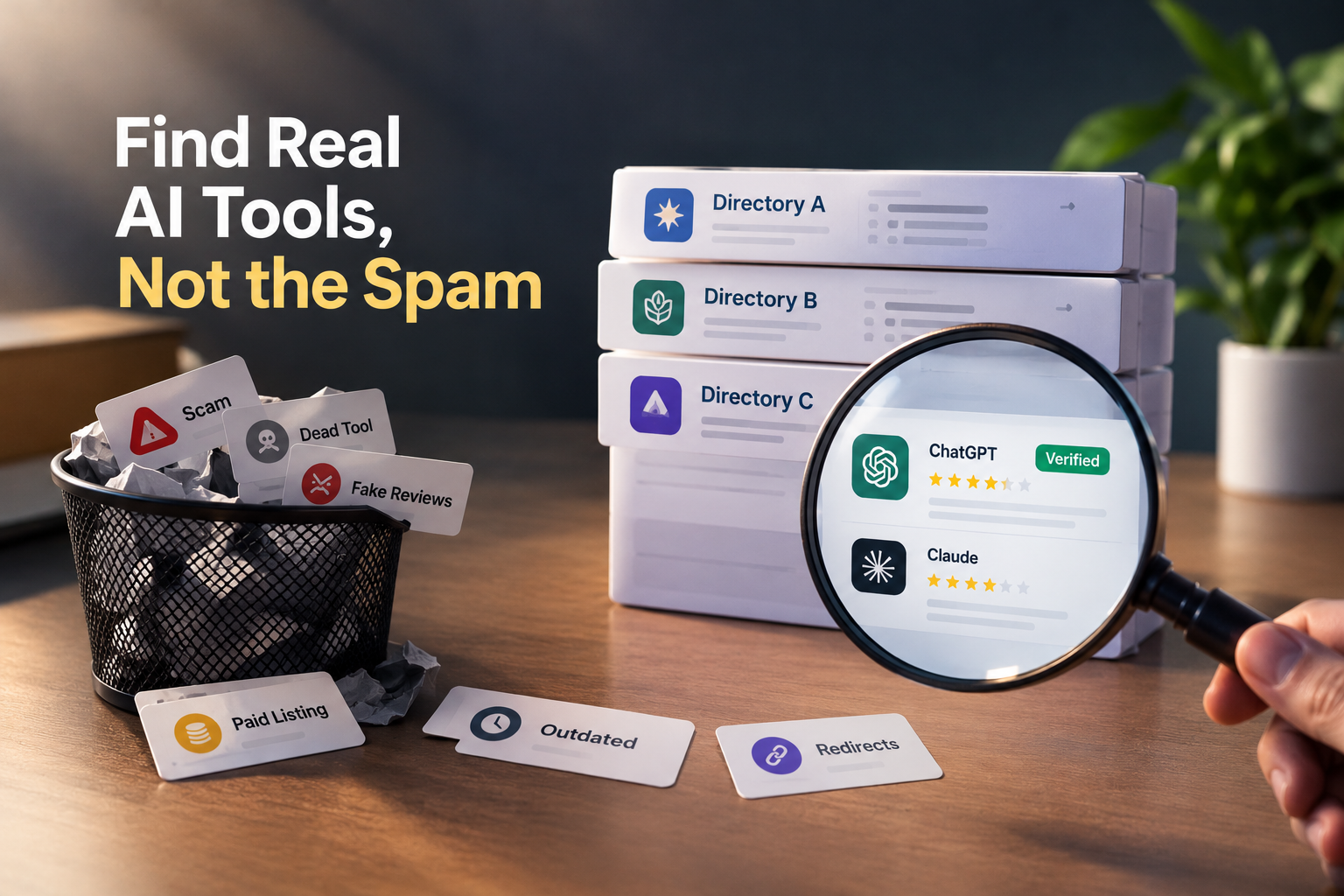
Most AI tool directories are not neutral. A 2026 audit found 34% of listed “AI tools” were dead, parked, or scams. To find real tools, cross-check three independent directories, audit the rating spread, trace badges to payment, and verify on the vendor’s own documentation. Here is the exact 60-second system.
The safest way to find AI tools without spam is to treat every directory as a shop window with a landlord: cross-check three independent sources, run a 60-second integrity audit, and verify every tool on its own documentation before you sign up.
That sounds simple. It is not. The AI tool market is churning faster than the directories that list it. A 2026 review of 15,356 listed “AI tools” found that 5,238 which is 34.1% were dead, parked, scams, agencies, libraries, or ordinary software that had added an AI feature. Among the failures, 565 were outright scams, mostly fake “AI trading” or investment platforms, and 359 redirected somewhere else entirely some to gambling or adult sites.
The problem is not that directories exist. It is that many of them earn money from the tools they rank, and very few disclose how the ranking actually works. Your job is to separate the directory’s revenue model from its editorial judgment. Here is how to do it in under two minutes.
Why Is Finding AI Tools Without Spam So Hard in 2026?
Because the barrier to launching an “AI-powered” product collapsed to roughly a weekend and an API key, and directories became the shop window for thousands of tools at once. When the storefront earns money from the products on its shelves, the star rating stops being a neutral fact.
Three shifts made this worse in 2026:
-
Fake reviews got fluent and free. Language models write specific, plausible, typo-free reviews at any volume. The old tells the broken English, wild enthusiasm and no longer separate real from fake.
-
Directories blend editorial picks with paid placement. The order tools appear in is frequently influenced by fees or affiliate deals, and the disclosure is often buried or missing.
-
AI search now cites directories. When ChatGPT or Perplexity recommends a tool, it may be leaning on a directory or review platform. A manufactured rating can travel into an AI answer with its context stripped away.
The scale is enormous. Trustpilot removed 4.5 million fake reviews in 2024 alone about 7.4% of everything submitted to the platform that year. That is one platform, with detection systems. Directories without such systems are catching a far smaller share.
What Are the 7 Red Flags of a Dishonest AI Tool Directory?
1. The rating spread test: every tool is between 4.2 and 4.9
Open any category page. If every single tool sits between 4.2 and 4.9 stars, and nothing ever drops below a 4, the number is not discriminating between good and bad and it is decorating. A real rating distribution has a left tail. A paid ranking does not.
2. A review count that never moves
Check back in three months. A real, live rating shifts as usage grows. A static “247 reviews” that has been static since the page was built is a number someone typed in once.
3. No cons, ever
A tool with zero listed weaknesses either has no honest reviewer, or the negative feedback was filtered before you saw it. A review with no real cons is marketing with punctuation.
4. The ranking moves when the pricing does
Save a snapshot of the list today or find one in the Wayback Machine and compare in six months. Did every vendor that got promoted recently start advertising with the directory? Did demoted vendors quietly stop? Rankings that move with commercial relationships are doing commercial work.
5. Sponsored entries are interleaved with editorial results
Ethical directories label advertising: “Sponsored,” “Ad,” “Featured partner.” The important part is not that the label exists but it is that labelled items stay structurally separate from ranked results. Watch for “Featured” badges that appear exclusively on vendors who also have a paid profile.
6. No named author and no reproducible methodology
A methodology page is a good sign but only if the rule is reproducible (“sorted by re-test date, then score”) rather than vibes (“editor’s pick”). If they do not say what the order means, the order means “who paid”.
7. The directory has no skin in the game
Ask: how are records sourced, and when was each last re-checked? Is there a published policy on paid placements and even if the answer is “we sell them, and here is exactly where”? Directories confident in their evidence show the evidence. Directories whose revenue depends on ambiguity show testimonials.
The badge translation table
| Badge / Label | What it usually means | What to do |
|---|---|---|
| “Featured” | Often a paid slot. May be disclosed in a tooltip or footer. | Treat as advertising until the directory’s disclosure page says otherwise. |
| “Verified” | Frequently verifies that the listing exists, not that the tool is good. | Check what is being verified: domain ownership? payment? editorial test? |
| “Sponsored” | Paid placement. | Fine if structurally separate from organic results; a red flag if interleaved. |
| “Editor’s Pick” | Can be genuine but only if a named editor and a stated criterion exist. | Look for the byline and the rule. If neither exists, assume it is commercial. |
| No badge, no disclosure | The default state of most directories. | Run the rating spread test and the pricing-movement test. |
How Do You Run a 60-Second Directory Integrity Audit?
Use this five-point scorecard on any directory you are about to trust.
| Check | Pass | Fail |
|---|---|---|
| 1. Rating spread | At least one tool below 4.0, or a visible distribution. | Everything is 4.2 - 4.9. |
| 2. Disclosure placement | “Sponsored” or “Ad” labels are visible on the card, and paid slots are separated from ranked results. | No labels, or labels only on hover. |
| 3. Methodology page | A reproducible ordering rule a stranger could apply. | “Editor’s pick” with no criteria. |
| 4. Named byline | A human author with a relevant background, or a named editorial team with a contact page. | Anonymous “Editorial Team” with no contact. |
| 5. Freshness | A visible “last checked” or “last updated” date on individual listings. | No dates anywhere. |
Score 3 or more passes: use the directory as a discovery layer, not a verdict. Score 2 or fewer: close the tab.
Where Should You Actually Look for AI Tools?
The best discovery workflow is a ladder, not a single directory. Each rung does a different job.
Rung 1: Practitioner blogs and newsletters
Operators who use the tools daily not directory curators are the closest thing to independent signal. Look for specific workflow screenshots, pricing details, and named limitations. A practitioner who says “we cancelled this after two weeks because the API rate limits broke our pipeline” is worth ten five-star directory listings.
Rung 2: Reddit, Slack, and niche communities
Reddit threads and private Slack communities are where the unfiltered version lives. Search for the tool name plus “worth it,” “refund,” or “alternative.” A thread with mixed opinions and specific complaints is more trustworthy than a page where every comment is a testimonial.
Rung 3: YouTube workflow walkthroughs
Video is harder to fake. You can see the interface, the outputs, and the real workflow including the loading spinners and the error messages that polished review pages edit out.
Rung 4: The vendor’s own documentation
This is the final check, not the first. Go to the company’s official domain independently but do not click through from the directory and read the docs, the pricing page, and the privacy policy. A tool that cannot produce a docs root, a verifiable pricing page, or a data-training disclosure is not ready for your workflow.
A well-run directory can still be a use uiqueness, and description accuracy. That does not make it a verdict. It makes it a map with a legend.
Can a Paid Directory Still Be Trustworthy?
Yes and if the payment buys placement, not verdict.
The distinction is structural, not moral. A directory can charge for a featured slot, a richer profile, or a faster review queue. What it must not do is let payment change the ranking rule or the rating without disclosure. When a directory separates “sponsored” from “organic” and publishes the ordering rule, a paid directory is simply a business with an advertising product. When it interleaves paid slots with editorial results and labels them with a faint hover badge, the ranking is for sale and the reviews are set dressing.
A practical rule: if you cannot tell which slots are paid, assume the top three are.
How Can You Verify a Tool Before You Sign Up?
Use a three-layer habit.
Layer 1 — Discovery: Use a directory (or a community) to find the tool. Do not make a decision here.
Layer 2 — Cross-reference: Check the tool on at least two independent platforms. A review marketplace, a Reddit thread, and a YouTube walkthrough will disagree with each other. That disagreement is information.
Layer 3 — Primary evidence: Go to the vendor’s official documentation. Confirm the feature exists, the price is real, and the data policy is stated in the vendor’s own words. Microsoft’s AI selection guidance puts it plainly: prefer tools with data isolation (no training on user inputs), encryption, and strong access controls and avoid personal accounts for work data.
One citable habit from the research: 88% of AI-search users still fact-check results by checking the underlying sources and reviews. The other 12% are the reason fake directories still work.
The bottom line
Finding AI tools without spam is not about finding a perfect directory. It is about building a three-layer habit and discover broadly, cross-check narrowly, verify on primary evidence and refusing to let a star rating do the work of a test drive. A directory with a public methodology and a human review process is a useful starting point. A directory with a uniform 4.8 and a buried disclosure is a billboard. Know which one you are reading.
Discover Tools Mentioned in this Guide
Explore our curated database of 2,600+ verified artificial intelligence software, benchmarks, and honest user reviews.
Related Guides & Articles
ChatGPT for Brand Voice: Can It Sound Like You?
ChatGPT for brand voice works when you stop asking it to be your brand and start giving it the constraints, examples, and behavioral rules it needs to match your brand. The model is a voice-matching engine, not a brand guardian.
ChatGPT for Marketing: The Complete 2026 Guide
A 2026 evidence-based guide to ChatGPT for marketing that leads with the 6.5% ROI measurement gap, introduces the 5PMS prompt framework, and links eight use-case clusters which is built for search rankings and AI citations, not generic coverage.

Best AI Tools for Real Estate Agents in 2026: Listings, Leads and Follow-Up
The best AI stack for most real estate agents in 2026 is ChatGPT Plus ($20/mo) for listing copy and emails**, **Canva (free–$15/mo) for marketing visuals, and Follow Up Boss ($69/user/mo) for CRM-driven follow-up**. Agents who buy leads should add **Structurely ($179+/mo) for 24/7 qualification. Teams farming for sellers should evaluate SmartZip for predictive prospecting. That’s the short version. The rest of this guide explains why those tools made the cut, where the cheaper and more expensive alternatives fit, and how to avoid the most common AI mistake agents make in 2026: stacking tools that do the same job while leaving the real bottleneck untouched.