

Claude Sonnet 5.5
By Claude Sonnet 5.5
Next-generation AI assistant built for complex reasoning, writing, and coding.
Overview
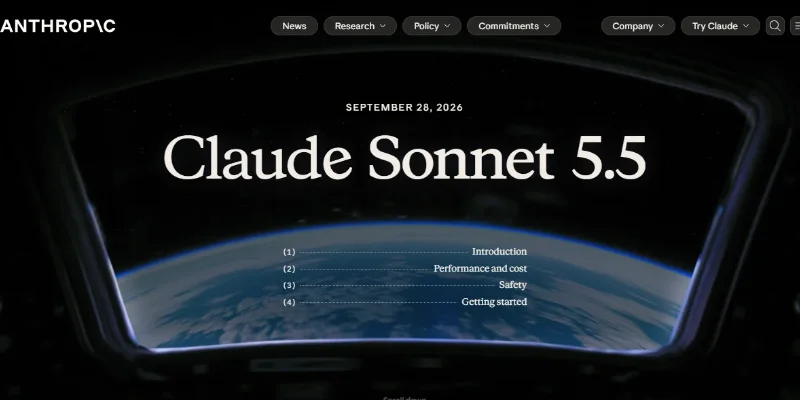
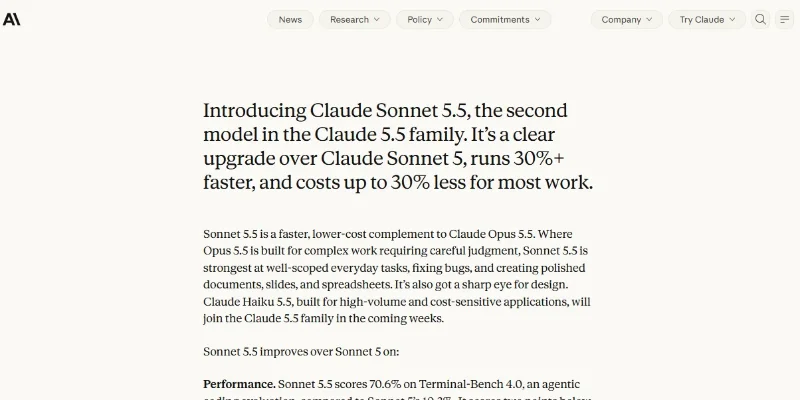
Summary: Claude Sonnet 5.5 is Anthropic's AI model designed for coding, everyday knowledge work, and reliable execution of well-defined tasks. Announced on September 28, 2026, it offers improvements over Claude Sonnet 5, runs more than 30% faster, and costs up to 30% less for most workloads, according to Anthropic. It supports text and image inputs and can help users write code, fix bugs, analyze information, create documents, build slides, and automate structured workflows. It is available through Claude.ai, the Claude Platform API, and supported cloud platforms.
What is Claude Sonnet 5.5?
Claude Sonnet 5.5 is a large language model developed by Anthropic as part of its Claude AI family. It is designed to balance capability, speed, and operating cost for practical professional and development tasks. The model can interpret text and image inputs, generate written responses, analyze documents, assist with software development, and support agent-based workflows that require multiple steps. Developers can use it to build AI applications and agents, while individual users can access it through Claude.ai. Anthropic highlights bug fixing, code review, document creation, spreadsheet work, slide design, research, and structured task execution as important use cases. API users can also adjust the model's thinking effort to suit different tasks.
Verifiable Stats:
-
Developer: Claude Sonnet 5.5 is developed by Anthropic, an AI research and product company.
-
Announcement date: Anthropic announced Claude Sonnet 5.5 on September 28, 2026.
-
Speed improvement: Anthropic reports that Sonnet 5.5 runs more than 30% faster than Sonnet 5.
-
Cost improvement: Anthropic says Sonnet 5.5 costs up to 30% less for most workloads compared with Sonnet 5.
-
API input pricing: The published API price is $2 per million input tokens.
Screenshots & Demo
Key Features
Core capabilities and functionalities provided by Claude Sonnet 5.5.
Context-Aware Code Completion & Synthesis
Delivers low-latency inline code completions, multi-token suggestions, and semantic completions customized to the repository context.
Multi-File Codebase Indexing & Exploration
Deeply scans project files, dependency trees, and symbol references to provide comprehensive cross-file edits and refactorings.
Automated Git & Terminal Workflow Automation
Executes shell commands, analyzes test runs, resolves syntax and runtime bugs, and crafts clean commit messages and pull requests.
Architectural Refactoring & Security Audit
Spots security vulnerabilities, dead code paths, and architectural smells, providing one-click semantic fixes and unit tests.
Pros & Cons
Key strengths and potential limitations of Claude Sonnet 5.5.
What We Like
- Fast AI Performance: Generates responses more than 30% faster than Sonnet 5, helping developers and professionals complete routine tasks more quickly.
- Strong Coding Capabilities: Helps build features, fix bugs, review code, and work with existing codebases across the software development lifecycle.
- Cost-Efficient API Usage: Offers API pricing of $2 per million input tokens and $10 per million output tokens, with improved token efficiency that can reduce the cost per task.
- Large Context Window: Supports a context window of up to 1 million tokens, useful for analyzing large documents and working with extensive codebases.
- Versatile Knowledge Work: Assists with document creation, spreadsheet analysis, slide preparation, visual design, and structured agent workflows.
Where It Falls Short
- API Costs Can Accumulate: Although pricing is competitive, high-volume applications and long outputs can still generate significant usage costs.
- Not Always the Best for Complex Tasks: Anthropic positions Opus 5.5 as stronger for complex, open-ended work requiring sustained judgment.
- Outputs Need Human Review: Generated code, analysis, documents, and calculations may contain errors and should be checked before use.
- Safety Restrictions Can Interrupt Workflows: Certain high-risk cybersecurity and biological requests may be blocked or trigger a fallback to another model.
- Developer Migration May Require Changes: Moving from Sonnet 5 can require API or application updates because some tool settings and response behaviors have changed.
Use Cases
Discover common workflows and scenarios where Claude Sonnet 5.5 excels.
AI-Powered Software Development
Generate code, implement new features, and build application components using natural-language instructions. Developers can use Claude Sonnet 5.5 to accelerate routine programming tasks.
Code Debugging and Error Resolution
Analyze error messages, identify potential bugs, and suggest fixes for existing code. Developers can use it to understand problems and improve software reliability.
Code Review and Refactoring
Review code for potential issues, readability, and maintainability. The model can suggest refactoring approaches that help teams keep their codebases organized.
AI Agent Development
Build AI-powered agents that perform defined, multi-step workflows, such as reviewing information, preparing reports, and coordinating development tasks through supported tools and integrations.
Document Creation and Editing
Draft reports, proposals, summaries, technical documentation, and business communications. Users can refine tone, structure, and clarity through iterative prompts.
Data Analysis and Spreadsheet Assistance
Interpret structured information, help write formulas, identify trends, and explain data patterns. Users should independently verify calculations and conclusions before making important decisions.
Research and Information Synthesis
Summarize lengthy documents, compare information from multiple supplied sources, and organize findings into structured reports. Factual claims should be checked against reliable sources.
Presentation and Slide Preparation
Develop presentation outlines, organize key messages, and draft slide content for business meetings, educational sessions, and project updates.
Similar AI Tools





Latest from Our Blog
Tips, tutorials and insights about AI tools and how to use them effectively.

ChatGPT for Brand Voice: Can It Sound Like You?

ChatGPT for Marketing: The Complete 2026 Guide

Best AI Tools for Real Estate Agents in 2026: Listings, Leads and Follow-Up
Google Gemini vs ChatGPT: Which AI Assistant Should You Actually Use?
Reviews & Community Ratings
Average rating: 5.0 out of 5 (1 total reviews)
Rate Claude Sonnet 5.5
Community Reviews (0)