

Papaya
By Papaya
Find What’s Breaking Your AI Agents and Discover How to Fix It.
Overview
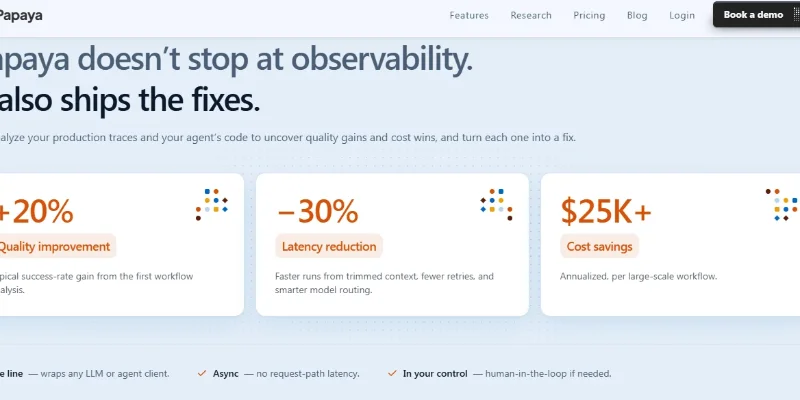
Summary: Papaya is an AI agent optimization platform that helps engineering teams improve the quality, speed, and cost efficiency of production AI agents. It ingests live traces via a lightweight SDK and runs 200+ research-backed analyses to surface recurring failures, context bloat, inefficient prompts, excessive tool calls, and model-routing issues. Papaya ranks every recommendation by expected impact and opens pull requests with concrete code fixes for human review. Teams using Papaya report 20%+ improvements across quality, latency, and cost.
What is Papaya?
Papaya is a continuous optimization and observability platform built specifically for teams operating AI agents in production. Unlike traditional observability tools that only show what happened during a single run, Papaya analyzes patterns across thousands of conversations and workflows to identify issues that repeatedly degrade user outcomes, increase latency, or inflate operating costs. The platform groups production traces by business use case, highlights recurring failure patterns, and provides evidence-backed recommendations linked directly to the runs that produced them. Its analysis layer covers prompts, planning, context and memory, retrieval, tool execution, subagents, prompt caching, and model selection. Papaya connects through its SDK, accepts OpenTelemetry data or exports from existing observability tools, and can analyze datasets in multiple formats. Connecting a source repository is optional, but it allows Papaya to pinpoint root causes and propose targeted fixes as pull requests. Approved changes ship through the team’s normal review workflow, while Slack alerts notify teams of new findings. The platform also provides live performance monitoring, automated evaluation rubrics using an LLM judge, and tracking for quality, latency, and cost. Trace collection is asynchronous, so it avoids adding latency to the agent’s request path.
Verifiable Stats:
-
Tool Type: AI Agent Optimization / AI Observability / LLM Evaluation.
-
Primary Purpose: Improve AI agent quality, latency, reliability, and cost efficiency.
-
Analysis Coverage: 200+ research-backed analyses across agent behavior, configuration, prompts, context, caching, subagents, and tool calls.
-
Reported Impact: Teams running Papaya see 20%+ improvements to quality, latency, and cost; individual workflow analyses typically surface 10%+ quality improvements on the first pass.
-
Supported Integrations: OpenAI, Anthropic, Vercel AI SDK, Amazon Bedrock, and Google Gemini through the documented SDK; also supports custom agent loops and existing trace exports.
-
Trace Data: Supports production traces, OpenTelemetry data, and datasets or raw exports in different formats.
-
Code Integration: Optional repository connection for identifying causes and preparing pull requests.
-
Company Stage: Founded September 2026 in San Francisco; Y Combinator Fall 2026 (F26) batch; $125K raised to date.
Screenshots & Demo

Key Features
Core capabilities and functionalities provided by Papaya.
Context-Aware Code Completion & Synthesis
Delivers low-latency inline code completions, multi-token suggestions, and semantic completions customized to the repository context.
Multi-File Codebase Indexing & Exploration
Deeply scans project files, dependency trees, and symbol references to provide comprehensive cross-file edits and refactorings.
Automated Git & Terminal Workflow Automation
Executes shell commands, analyzes test runs, resolves syntax and runtime bugs, and crafts clean commit messages and pull requests.
Architectural Refactoring & Security Audit
Spots security vulnerabilities, dead code paths, and architectural smells, providing one-click semantic fixes and unit tests.
Pros & Cons
Key strengths and potential limitations of Papaya.
What We Like
- Automated AI Agent Optimization: Analyzes production traces to identify recurring failures, inefficient prompts, and opportunities to improve agent performance.
- Quality, Latency, and Cost Insights: Helps development teams understand how agent behavior affects response quality, execution speed, and operating expenses.
- Broad Integration Support: Supports documented integrations and trace ingestion methods for connecting AI workflows and existing observability systems.
- Code-Level Recommendations: With an optional repository connection, Papaya can help trace issues to their source and prepare suggested code changes as pull requests for review.
- Continuous Monitoring and Evaluation: Provides performance monitoring, evaluation tools, and alerts to help teams detect recurring issues and quality changes over time.
Where It Falls Short
- Primarily Designed for Developers: Teams without experience in AI agents, APIs, or production monitoring may find setup and analysis challenging.
- Requires Useful Trace Data: The quality of its findings depends on the availability and quality of production traces, evaluations, and other relevant data.
- Integration Setup Takes Effort: Connecting SDKs, observability platforms, or code repositories may require engineering time and configuration.
- Recommendations Need Human Review: AI-generated findings and proposed code changes should be tested and reviewed before deployment.
- Usage-Based Costs May Increase: Paid plans based on trace volume may become more expensive as an application grows. Teams should check current pricing and usage limits before scaling.
Use Cases
Discover common workflows and scenarios where Papaya excels.
AI Agent Performance Optimization
Analyze production traces to identify recurring failures, inefficient execution patterns, and opportunities to improve AI agent performance.
Prompt Optimization
Identify prompts that produce inconsistent or incorrect outputs and investigate opportunities to improve instructions, reduce unnecessary tokens, and achieve more reliable results.
AI Application Cost Reduction
Analyze token consumption, model selection, context usage, and caching opportunities to find potential ways to reduce AI operating costs.
Latency and Response-Time Improvement
Investigate slow agent workflows, inefficient tool calls, and unnecessary processing steps to identify opportunities to improve response times.
Production Error Detection
Review recurring errors and failed agent runs to help engineering teams prioritize issues affecting real users.
AI Agent Quality Evaluation
Use automated evaluation criteria to assess agent outputs, identify quality gaps, and track whether implemented changes improve results.
Tool-Calling Reliability
Investigate failures involving external tools, API calls, and agent execution steps to help improve workflow reliability.
Context and Memory Optimization
Analyze how context size, memory usage, and retrieval behavior affect agent performance, helping teams identify unnecessary context or ineffective information retrieval.
Similar AI Tools





Latest from Our Blog
Tips, tutorials and insights about AI tools and how to use them effectively.

ChatGPT for Brand Voice: Can It Sound Like You?

ChatGPT for Marketing: The Complete 2026 Guide

Best AI Tools for Real Estate Agents in 2026: Listings, Leads and Follow-Up

Google Gemini vs ChatGPT: Which AI Assistant Should You Actually Use?
Reviews & Community Ratings
Average rating: 8.5 out of 5 (1 total reviews)
Rate Papaya
Community Reviews (0)