

reAPI
By reAPI
Next-generation AI code assistant with deep multi-file repository understanding.
Overview
Summary
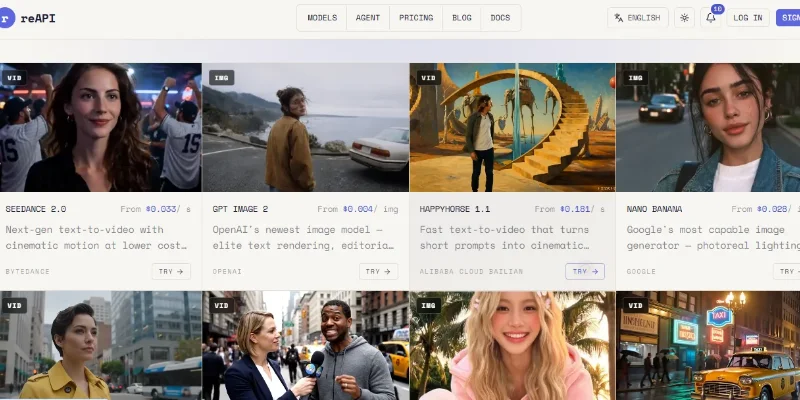
reAPI is an AI API aggregation platform that gives developers access to multiple AI models for text, image, video, audio, and code generation through a unified API infrastructure. It simplifies integration with different AI providers by offering centralized access, usage-based billing, and automated routing and failover features.
What Is reAPI?
reAPI helps developers and businesses integrate multiple AI models into their applications without managing separate integrations for every provider. It supports AI chat and language models alongside media-generation models for creating images, videos, and audio content.
The platform provides API endpoints compatible with established SDK conventions, allowing developers to connect supported models by configuring the appropriate base URL and API key. This can reduce integration work when experimenting with different models or switching between providers.
Verifiable Stats
-
Supported AI categories: Text, image, video, audio, and code-related workloads.
-
Billing model: Pay-as-you-go credits for supported services.
-
Integration approach: Unified API endpoints with support for compatible SDKs.
Screenshots & Demo


Key Features
Core capabilities and functionalities provided by reAPI.
Context-Aware Code Completion & Synthesis
Delivers low-latency inline code completions, multi-token suggestions, and semantic completions customized to the repository context.
Multi-File Codebase Indexing & Exploration
Deeply scans project files, dependency trees, and symbol references to provide comprehensive cross-file edits and refactorings.
Automated Git & Terminal Workflow Automation
Executes shell commands, analyzes test runs, resolves syntax and runtime bugs, and crafts clean commit messages and pull requests.
Architectural Refactoring & Security Audit
Spots security vulnerabilities, dead code paths, and architectural smells, providing one-click semantic fixes and unit tests.
Pros & Cons
Key strengths and potential limitations of reAPI.
What We Like
- Unified AI API Access: Connect to multiple AI models through a centralized API instead of integrating every provider separately.
- Multimodal Capabilities: Supports access to models for text, image, video, audio, and other AI-generation workflows.
- Developer-Friendly Integration: Compatible API formats and familiar SDK patterns can simplify integration into existing applications.
- Flexible Usage-Based Billing: Credit-based pricing lets developers pay according to usage rather than necessarily committing to a fixed monthly subscription.
- Routing and Failover Options: The gateway advertises automated routing, retries, and failover mechanisms that can help handle upstream provider errors
Where It Falls Short
- Third-Party Dependency: Requests depend on reAPI's infrastructure and the availability of the underlying AI providers
- Costs Vary by Model: Different models and generation types may have different credit requirements, making costs harder to predict without monitoring usage.
- Feature Availability Varies: Not every model or capability necessarily supports the same parameters, formats, or API behavior.
- Additional Integration Layer: Developers may need to troubleshoot issues across both reAPI and the upstream model provider.
- Privacy and Compliance Checks: Businesses should review data retention, processing locations, and applicable privacy terms before sending confidential information through an intermediary API.
Use Cases
Discover common workflows and scenarios where reAPI excels.
AI Chatbot Development
Integrate supported language models into chatbots, virtual assistants, and customer-support applications without creating a separate integration for every model provider.
AI-Powered SaaS Applications
Build AI-enabled software products that use text generation, summarization, question answering, and other supported model capabilities through API requests.
AI Image Generation
Add text-to-image generation to applications such as design tools, content platforms, marketing systems, and creative applications using supported image models.
AI Video Generation
Integrate supported video-generation models into applications that create promotional clips, social media videos, product demonstrations, or other short-form visual content.
Audio Generation and Processing
Connect supported audio models to applications involving speech generation, voice-based experiences, and other available audio workflows.
Multi-Model Application Development
Experiment with different AI models through a centralized API layer to compare output quality, latency, and cost for specific application requirements.
AI Content Creation Platforms
Build tools that generate marketing copy, articles, product descriptions, creative concepts, and other text-based content using compatible language models.
Automated AI Workflows
Connect supported AI endpoints to applications that automate content generation, data transformation, summarization, and other repeatable tasks.
Similar AI Tools







Latest from Our Blog
Tips, tutorials and insights about AI tools and how to use them effectively.

ChatGPT for Brand Voice: Can It Sound Like You?

ChatGPT for Marketing: The Complete 2026 Guide

Best AI Tools for Real Estate Agents in 2026: Listings, Leads and Follow-Up
Google Gemini vs ChatGPT: Which AI Assistant Should You Actually Use?
Reviews & Community Ratings
Average rating: 8.5 out of 5 (1 total reviews)
Rate reAPI
Community Reviews (0)