Camel AI
By Camel AI
Context-aware software development platform for rapid engineering workflows.
Overview
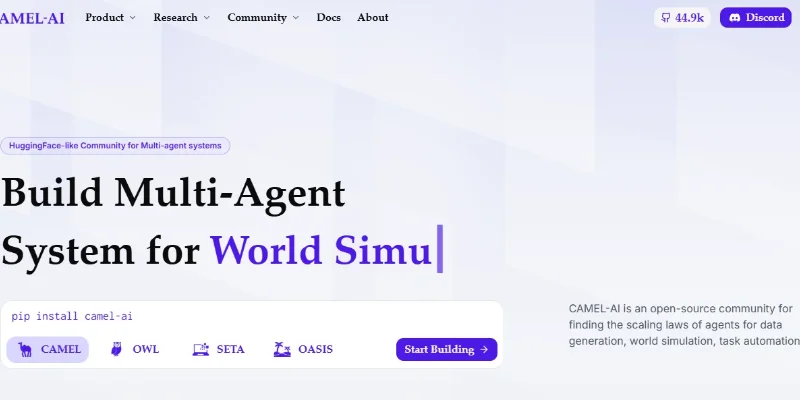
Summary: CAMEL-AI is an open-source AI agent framework and research community focused on building, coordinating, and studying autonomous multi-agent systems. It enables developers and researchers to create AI agents that collaborate, communicate, plan tasks, use external tools, generate synthetic data, and automate complex workflows. Its ecosystem includes the CAMEL framework, Workforce, OWL, OASIS, and other agent research projects designed for scalable AI automation, world simulation, and multi-agent collaboration.
What is CAMEL-AI?
CAMEL-AI (Communicative Agents for Mind Exploration of Large Language Model Society) is an open-source platform designed to help developers build intelligent AI agents and multi-agent societies. Rather than relying on a single AI assistant to complete every task, CAMEL allows multiple specialized agents to work together by assigning different roles, sharing information, coordinating activities, and solving complex problems.
The CAMEL framework provides tools for creating single-agent and multi-agent applications. Developers can build agents for research, planning, reasoning, task execution, information retrieval, and software development. Its Workforce component allows users to organize agents into teams with specific responsibilities and hierarchies, enabling them to handle longer and more complex tasks.
CAMEL-AI also provides a comprehensive toolkit for integrating external tools and services into AI workflows. Its ecosystem includes browser automation, code execution, web search, file processing, Gmail, Google Calendar, GitHub, Slack, SQL, retrieval systems, and Model Context Protocol (MCP) integrations. These capabilities allow developers to build agents that interact with external applications and perform practical tasks.
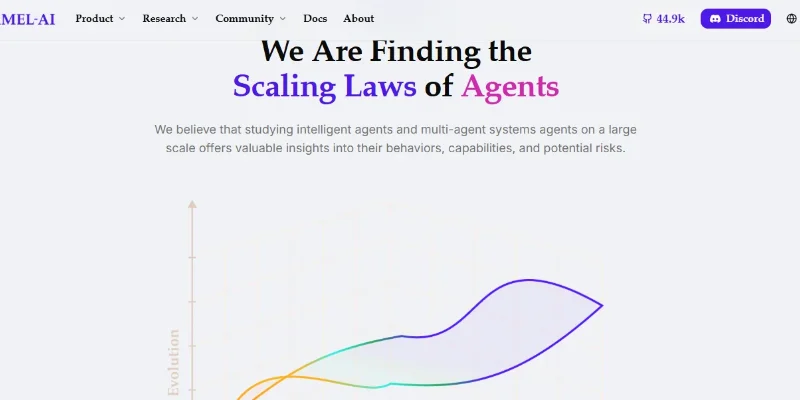
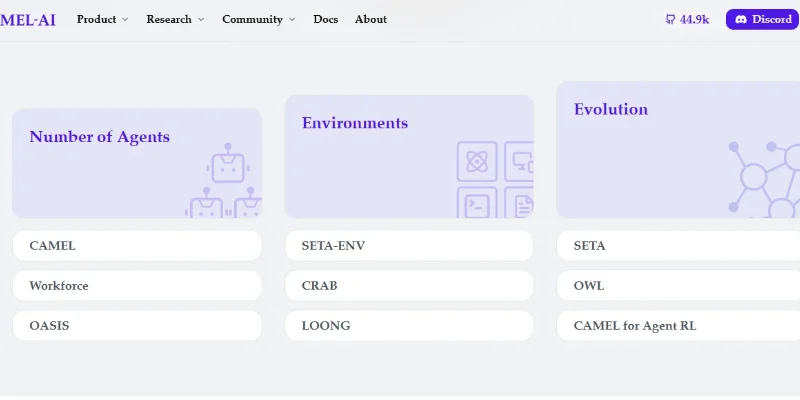
Another important area of CAMEL-AI is synthetic data generation and agent research. Its research projects include OASIS for large-scale social interaction simulations, OWL for real-world task automation, and SETA for agent evolution and related research. The framework also supports memory management, reinforcement-learning workflows, evaluation, and observability for developing more scalable and reliable agent systems.
Verifiable Stats:
-
Developer/Organization: CAMEL-AI open-source research community.
-
Founder: Guohao Li.
-
Platform Type: Open-source AI agent framework and multi-agent research ecosystem.
-
Primary Purpose: Building, coordinating, researching, and scaling autonomous AI agents.
-
Core Framework: CAMEL multi-agent framework.
-
Agent Capabilities: Role assignment, task planning, reasoning, communication, memory, and tool usage.
-
Multi-Agent System: Workforce supports coordinated AI teams with roles, hierarchies, and long-term tasks.
-
Research Projects: OWL, OASIS, SETA, CRAB, and LOONG.
-
Data Generation: Supports synthetic data generation, self-instruction, and self-improving data pipelines.
-
Integrations: Browser, GitHub, Gmail, Google Calendar, Slack, SQL, MCP, and other external tools.
-
Programming Ecosystem: Python-based framework with developer documentation and open-source code.
-
Target Audience: AI developers, machine learning researchers, data scientists, automation engineers, and organizations building multi-agent applications
Screenshots & Demo
Key Features
Core capabilities and functionalities provided by Camel AI.
Context-Aware Code Completion & Synthesis
Delivers low-latency inline code completions, multi-token suggestions, and semantic completions customized to the repository context.
Multi-File Codebase Indexing & Exploration
Deeply scans project files, dependency trees, and symbol references to provide comprehensive cross-file edits and refactorings.
Automated Git & Terminal Workflow Automation
Executes shell commands, analyzes test runs, resolves syntax and runtime bugs, and crafts clean commit messages and pull requests.
Architectural Refactoring & Security Audit
Spots security vulnerabilities, dead code paths, and architectural smells, providing one-click semantic fixes and unit tests.
Pros & Cons
Key strengths and potential limitations of Camel AI.
What We Like
- Open-Source and Flexible Framework: CAMEL-AI provides an open-source framework that developers can inspect, customize, and extend. This gives technical teams greater control over how their AI agents are designed and deployed.
- Advanced Multi-Agent Collaboration: Its multi-agent architecture allows different AI agents to work together by assigning specialized roles and responsibilities. This is useful for solving complex tasks that require multiple stages of reasoning and execution.
- Workforce for Task Automation: The Workforce component helps organize AI agents into coordinated teams. Developers can assign tasks, manage agent responsibilities, and build workflows for longer-running automation projects.
- Extensive Tool Integration: CAMEL-AI supports integrations with external tools and services, including web browsers, GitHub, Gmail, Google Calendar, Slack, SQL, and MCP-compatible tools. This expands the range of tasks that agents can perform.
- Synthetic Data Generation: Its data-generation capabilities help researchers create artificial datasets for AI training, experimentation, and evaluation. This can be valuable when collecting real-world data is difficult or expensive.
Where It Falls Short
- Requires Programming Knowledge: CAMEL-AI is primarily designed for developers and researchers. Users generally need Python knowledge and familiarity with APIs, language models, and software development to build and configure agents effectively.
- Complex Initial Setup: Installing dependencies, configuring model providers, setting API credentials, and connecting external tools can take time. Beginners may find the initial setup process challenging.
- External Model Dependencies: CAMEL-AI is an agent framework rather than a standalone AI model. Users typically need access to compatible LLM providers or locally hosted models, which may involve additional configuration and costs.
- API and Infrastructure Costs: Although the framework is open source, using commercial LLM APIs, cloud infrastructure, and external services can generate ongoing expenses. Costs may increase when multiple agents execute lengthy tasks.
- Multi-Agent Coordination Challenges: Coordinating several AI agents can introduce communication overhead, repeated operations, inconsistent outputs, and additional execution time. Complex workflows may require careful planning and testing.
Use Cases
Discover common workflows and scenarios where Camel AI excels.
Automated Web Research
Researchers can use CAMEL-AI to create AI agents that search websites, collect information, analyze sources, and prepare structured research reports. Multiple agents can work on different research topics simultaneously and combine their findings into a comprehensive result.
Multi-Agent Collaboration
CAMEL-AI allows developers to create teams of specialized AI agents that collaborate on complex tasks. For example, one agent can research a topic, another can analyze the collected information, and a third can prepare the final report.
Autonomous Task Automation
Businesses and developers can use CAMEL-AI to build agents that perform multi-step tasks with minimal human intervention. Agents can plan activities, use external tools, execute instructions, and coordinate with other agents to complete workflows.
AI-Powered Software Development
Software development teams can build AI agents that assist with code generation, debugging, documentation, testing, and programming research. Different agents can handle separate development responsibilities and combine their outputs into a coordinated workflow.
Synthetic Data Generation
Data scientists can use CAMEL-AI to generate artificial datasets for machine learning research and model training. Its data-generation capabilities can help create instruction datasets, question-answer pairs, reasoning examples, and structured information when suitable real-world data is limited.
Customer Support Automation
Developers can build multi-agent customer support systems using CAMEL-AI. One agent can understand customer questions, another can retrieve relevant documentation, and a response agent can prepare answers or escalate complicated inquiries to human support staff.
AI-Powered Market Research
Businesses can create research agents that investigate industries, analyze competitors, examine market trends, and summarize publicly available business information. This helps companies organize research activities and support strategic decision-making.
Business Process Automation
Organizations can use CAMEL-AI to automate repetitive business workflows involving document processing, information retrieval, data analysis, and external tool interactions. Multiple agents can divide responsibilities across different stages of a process.
Similar AI Tools

ChatGPT
Research, Write, Code, Analyze, and Create with OpenAI’s Multimodal AI Assistant.

Claude
Write, Code, Analyze, Research, and Automate Complex Tasks with Claude AI.

Grok -AI
Get Real-Time Answers, Research the Web, Code, and Create with Grok AI.

Google - Gemini
Research, Write, Code, and Create with Google’s Multimodal AI Assistant.
Wordware AI
Next-generation AI code assistant with deep multi-file repository understanding.

ChatGOT
Your All-in-One AI Chatbot Assistant
Zapier Agents
Next-generation AI code assistant with deep multi-file repository understanding.
Buda
AI-powered coding companion built for high-velocity software engineering.
Latest from Our Blog
Tips, tutorials and insights about AI tools and how to use them effectively.
ChatGPT for Brand Voice: Can It Sound Like You?
ChatGPT for Marketing: The Complete 2026 Guide

Best AI Tools for Real Estate Agents in 2026: Listings, Leads and Follow-Up