

Inkling
By Inkling
AI-powered coding companion built for high-velocity software engineering.
Overview
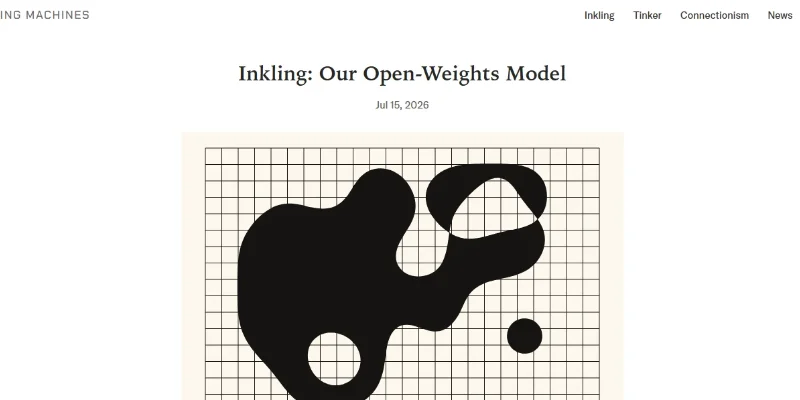
Summary: Inkling is an open-weight, multimodal AI model developed by Thinking Machines Lab, released on July 15, 2026. Built using a Mixture-of-Experts (MoE) transformer architecture, it supports text, image, and audio understanding, reasoning, coding, and AI agent workflows. The model has 975 billion total parameters, with 41 billion active parameters, and supports a context window of up to 1 million tokens. Developers can customize and fine-tune Inkling through the company's Tinker platform or deploy its weights through supported AI infrastructure providers.
What is Inkling?
Inkling is a general-purpose open-weight foundation model created by Thinking Machines Lab. It is designed to support a broad range of AI applications, including conversational assistants, coding tools, multimodal applications, and autonomous AI agents. Unlike proprietary models that restrict access to their underlying weights, Inkling makes its full model weights available so developers and researchers can customize and integrate it into their own applications.
The model uses a Mixture-of-Experts transformer architecture with 975 billion total parameters and 41 billion active parameters. It was pretrained on approximately 45 trillion tokens covering text, images, audio, and video. Its architecture is designed to balance performance and computational efficiency by activating only a portion of its parameters for each token.
Inkling natively processes text, image, and audio inputs, making it suitable for multimodal AI applications. Its capabilities include reasoning, instruction following, coding, factual question answering, visual understanding, audio processing, and tool use. It also supports controllable thinking effort, allowing developers to balance response quality, processing time, and computational cost.
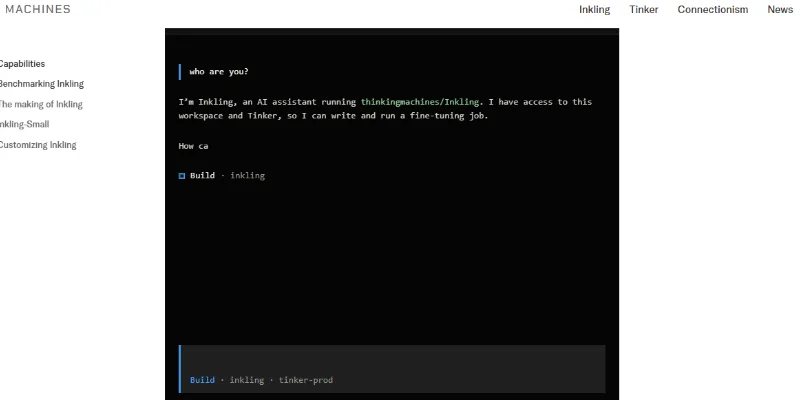
One of Inkling's major advantages is its customization capability. Through Tinker, Thinking Machines Lab's model-training platform, developers can fine-tune the model for specialized tasks and organizational requirements. The company also demonstrated Inkling fine-tuning itself to adopt a specific writing behavior, showcasing how its weights can be customized for targeted applications.
Inkling is designed for developers building AI-powered products rather than being only a consumer chatbot. Its weights are available through Hugging Face, while API and deployment options include Together AI, Fireworks, Modal, Databricks, and Baseten. It is released under the Apache 2.0 license, supporting research, customization, and commercial integration subject to the license terms.
Verifiable Stats
-
Tool Name: Inkling.
-
Developer: Thinking Machines Lab, Inc.
-
Launch Date: July 15, 2026.
-
Model Architecture: Sparse Mixture-of-Experts (MoE) transformer.
-
Total Parameters: 975 billion, with 41 billion active parameters.
-
Training Data: Approximately 45 trillion tokens of text, images, audio, and video.
-
Context Window: Up to 1 million tokens; Tinker currently offers 64K and 256K context options.
-
Input Modalities: Text, images, and audio.
-
Primary Capabilities: AI reasoning, coding, multimodal understanding, instruction following, and agentic tool use.
-
License: Apache 2.0 open-weight license.
Screenshots & Demo

Key Features
Core capabilities and functionalities provided by Inkling.
Context-Aware Code Completion & Synthesis
Delivers low-latency inline code completions, multi-token suggestions, and semantic completions customized to the repository context.
Multi-File Codebase Indexing & Exploration
Deeply scans project files, dependency trees, and symbol references to provide comprehensive cross-file edits and refactorings.
Automated Git & Terminal Workflow Automation
Executes shell commands, analyzes test runs, resolves syntax and runtime bugs, and crafts clean commit messages and pull requests.
Architectural Refactoring & Security Audit
Spots security vulnerabilities, dead code paths, and architectural smells, providing one-click semantic fixes and unit tests.
Pros & Cons
Key strengths and potential limitations of Inkling.
What We Like
- Open-Weight Model Accessibility: Inkling provides downloadable model weights under the Apache 2.0 license, allowing developers to customize, fine-tune, and integrate it into their own applications.
- Multimodal AI Capabilities: It natively supports text, image, and audio inputs, making it useful for developing advanced multimodal AI applications.
- Large Context Window: Its context window supports up to 1 million tokens, helping developers build applications that process large amounts of information.
- Flexible Fine-Tuning: Integration with the Tinker platform allows developers to customize model behavior and adapt it to specialized tasks.
- Efficient Mixture-of-Experts Architecture: Its 975-billion-parameter architecture activates approximately 41 billion parameters per token, helping balance model capability and computational efficiency.
Where It Falls Short
- High Hardware Requirements: Running the full model locally requires substantial GPU resources. Its BF16 checkpoint requires at least 2 TB of aggregated VRAM, making self-hosting difficult for smaller developers.
- Not the Strongest Overall Model: Thinking Machines Lab acknowledges that Inkling is not the strongest model available across all benchmarks and capabilities.
- Limited Output Modalities: Although it accepts text, images, and audio, its generated output is text-based rather than native image, audio, or video generation.
- Potential Hallucinations: Like other foundation models, Inkling can generate incorrect information, misunderstand instructions, or produce inconsistent answers during longer conversations.
- Additional Safety Measures Required: Developers deploying Inkling in public-facing applications may need external moderation, monitoring, and safeguards to handle harmful or adversarial prompts.
Use Cases
Discover common workflows and scenarios where Inkling excels.
AI Chatbot Development
Developers can use Inkling to build conversational AI assistants that answer questions, follow instructions, and provide context-aware responses for websites and applications.
AI Agent Development
Inkling supports tool calling and agentic workflows, allowing developers to create AI agents that interact with external tools and perform multi-step tasks.
Software Development and Coding
Software engineers can use Inkling for code generation, debugging assistance, programming explanations, and solving software development problems.
Multimodal Application Development
Developers can build applications that process text, images, and audio inputs, enabling more interactive and context-aware AI experiences.
Document Analysis and Information Extraction
Organizations can develop AI systems that analyze large volumes of textual information, extract important details, summarize content, and answer document-related questions.
Custom AI Model Fine-Tuning
Businesses and researchers can use the Tinker platform to customize Inkling's behavior for specialized workflows, industry-specific terminology, and domain-focused applications.
Voice-Based AI Assistants
Developers can build voice-enabled applications that process audio inputs and generate text responses for conversational interfaces and voice-driven workflows.
Research and Knowledge Assistance
Researchers can use Inkling to explore complex topics, summarize information, analyze textual material, and support multi-step reasoning tasks.
Similar AI Tools
Kimi K3
Context-aware software development platform for rapid engineering workflows.

Thoth Ai
AI Training Data & Model Reliability Platform

DeepSeek
Open-Source, High-Efficiency AI Models & Advanced Reasoning Engine

Vynaris
Hosted uncensored models for authorized security testing and research.

MCPhq
25,000+ MCP servers, ranked by installs and commit freshness.

SendHQ
Email API for developers and AI agents.

Erius Phone
Virtual phone infrastructure for AI agents.

BlazePhoenix
On-chain DEX quotes and staking. No keys, no servers.
Latest from Our Blog
Tips, tutorials and insights about AI tools and how to use them effectively.
The 10 Best AI Data Analysis Tools in 2026: ChatGPT, Copilot, and Julius AI Compared

Best AI Tools for Social Media and Thumbnails in 2026

Top AI Tool Directories to Submit To: Complete Guide (2026)
Best Paid AI Tools Worth the Money in 2026: Complete Guide
Reviews & Community Ratings
No reviews yet — be the first to rate and review this tool!
Rate Inkling
Community Reviews (0)