

Kimi K3
By Kimi K3
Context-aware software development platform for rapid engineering workflows.
Overview
Summary: Kimi K3 is an advanced open-weight AI model developed by Moonshot AI, designed for complex reasoning, long-horizon coding, multimodal understanding, and knowledge-intensive tasks. Built with a 2.8-trillion-parameter Mixture-of-Experts (MoE) architecture, it features native vision capabilities and a 1-million-token context window. The model supports software development, research, document analysis, visual reasoning, and autonomous AI workflows. Kimi K3 is accessible through Kimi.com, Kimi Work, Kimi Code, and the Kimi API.
What is Kimi K3?
Kimi K3 is a flagship large language model developed by Moonshot AI, a Chinese artificial intelligence company. It is designed to handle demanding AI tasks that require advanced reasoning, long-term context retention, coding capabilities, and multimodal understanding.
The model uses a Mixture-of-Experts architecture with 2.8 trillion total parameters and approximately 104 billion activated parameters. Its architecture combines Kimi Delta Attention (KDA), Attention Residuals (AttnRes), and a Stable LatentMoE framework to improve computational efficiency and information processing.
One of Kimi K3's major capabilities is its 1-million-token context window, allowing it to process extensive documents, large code repositories, research materials, and other information within a single context. Its native vision capabilities also allow it to understand visual inputs and work with image-based tasks.
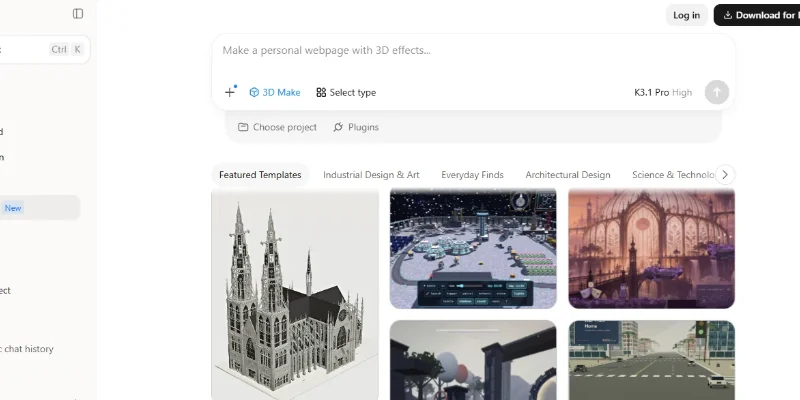
For software developers, Kimi K3 supports complex coding workflows, repository analysis, GPU kernel optimization, compiler development, and interactive application creation. It can also use visual feedback, such as screenshots, to refine software interfaces and interactive experiences.
Beyond coding, Kimi K3 supports knowledge-intensive workflows such as deep research, scientific analysis, document understanding, and the creation of interactive visualizations and dashboards. Its open-weight availability also gives developers and organizations opportunities to deploy, integrate, and experiment with the model.
Verifiable Stats
-
Developer: Moonshot AI.
-
Model Release: July 2026; the model was introduced publicly in July, with subsequent availability across additional platforms.
-
Model Architecture: Mixture-of-Experts (MoE), using Kimi Delta Attention and Attention Residuals.
-
Total Parameters: 2.8 trillion.
-
Active Parameters: Approximately 104 billion per token.
-
Context Window: 1,048,576 tokens (1 million tokens).
-
Supported Modalities: Text and image; the model's technical materials also describe video understanding capabilities.
-
Core Capabilities: Advanced reasoning, long-horizon coding, visual understanding, deep research, and agentic knowledge work.
-
Availability: Kimi.com, Kimi Work, Kimi Code, and Kimi API.
-
Open Weights: Released under the Kimi K3 License, enabling research, deployment, and further development.
Screenshots & Demo


Key Features
Core capabilities and functionalities provided by Kimi K3.
Context-Aware Code Completion & Synthesis
Delivers low-latency inline code completions, multi-token suggestions, and semantic completions customized to the repository context.
Multi-File Codebase Indexing & Exploration
Deeply scans project files, dependency trees, and symbol references to provide comprehensive cross-file edits and refactorings.
Automated Git & Terminal Workflow Automation
Executes shell commands, analyzes test runs, resolves syntax and runtime bugs, and crafts clean commit messages and pull requests.
Architectural Refactoring & Security Audit
Spots security vulnerabilities, dead code paths, and architectural smells, providing one-click semantic fixes and unit tests.
Pros & Cons
Key strengths and potential limitations of Kimi K3.
What We Like
- Massive 1-Million-Token Context Window: Kimi K3 can process extensive documents, large codebases, and lengthy research materials within a single context, making it useful for complex analysis.
- Advanced Coding Capabilities: It supports demanding software development workflows, including repository analysis, code generation, debugging, and technical problem-solving.
- Efficient Mixture-of-Experts Architecture: Its 2.8-trillion-parameter architecture activates approximately 104 billion parameters per token, helping balance model capacity and computational efficiency.
- Native Multimodal Understanding: Its visual capabilities allow users to work with image-based information alongside text, supporting document analysis and visual reasoning.
- Open-Weight Availability: Developers and researchers can access its model weights and build custom applications, integrations, and deployment workflows under the applicable model license.
Where It Falls Short
- High Self-Hosting Requirements: Despite its efficient MoE architecture, the 2.8-trillion-parameter model requires substantial computing infrastructure, making independent deployment challenging for smaller developers and businesses.
- Potentially Higher Operating Costs: Processing long contexts and complex reasoning tasks can consume significant computing resources, increasing API or hosting expenses for high-volume applications.
- Slower Responses for Complex Tasks: Kimi K3 uses reasoning-focused processing, and response times can increase when handling lengthy prompts, extensive coding tasks, or multiple tool calls.
- Performance Is Not Best in Every Task: Although it performs strongly in coding and reasoning, Moonshot AI acknowledges that its overall performance still trails some leading proprietary AI models.
- API Integration Limitations: Some third-party platforms have compatibility restrictions involving multi-turn reasoning history and document inputs. Developers may need to adjust their API integration or workflows
Use Cases
Discover common workflows and scenarios where Kimi K3 excels.
AI-Powered Software Development
Developers can use Kimi K3 to generate code, build application components, debug errors, and solve complex programming problems across different software projects.
Large Codebase Analysis
Software engineering teams can analyze extensive code repositories, understand dependencies, identify potential issues, and explore unfamiliar projects using its large context window.
Advanced Technical Research
Researchers can use Kimi K3 to analyze technical papers, compare research findings, summarize complex concepts, and organize information from lengthy documents.
Long-Document Analysis
Legal professionals, analysts, and business teams can process lengthy reports, contracts, manuals, and other documents to extract important information and generate structured summaries
AI Agent Development
Developers can build AI-powered agents that use reasoning and supported tool-calling capabilities to perform multi-step tasks, retrieve information, and coordinate workflows.
Visual Document Understanding
Users can provide supported image inputs, such as charts, diagrams, screenshots, and document pages, to extract information and understand visual content.
Data Analysis and Interpretation
Data professionals can use Kimi K3 to interpret datasets, explain analytical findings, generate code for data processing, and prepare structured reports.
Interactive Application Prototyping
Developers can use its coding and reasoning capabilities to create application prototypes, generate interface components, and refine implementations through iterative feedback.
Similar AI Tools
Inkling
AI-powered coding companion built for high-velocity software engineering.

Thoth Ai
AI Training Data & Model Reliability Platform

DeepSeek
Open-Source, High-Efficiency AI Models & Advanced Reasoning Engine

Vynaris
Hosted uncensored models for authorized security testing and research.

MCPhq
25,000+ MCP servers, ranked by installs and commit freshness.

SendHQ
Email API for developers and AI agents.

Erius Phone
Virtual phone infrastructure for AI agents.

BlazePhoenix
On-chain DEX quotes and staking. No keys, no servers.
Latest from Our Blog
Tips, tutorials and insights about AI tools and how to use them effectively.

The 10 Best AI Data Analysis Tools in 2026: ChatGPT, Copilot, and Julius AI Compared

Best AI Tools for Social Media and Thumbnails in 2026

Top AI Tool Directories to Submit To: Complete Guide (2026)

Best Paid AI Tools Worth the Money in 2026: Complete Guide
Reviews & Community Ratings
No reviews yet — be the first to rate and review this tool!
Rate Kimi K3
Community Reviews (0)