

Microduck
By Microduck
Next-generation AI code assistant with deep multi-file repository understanding.
Overview
Summary
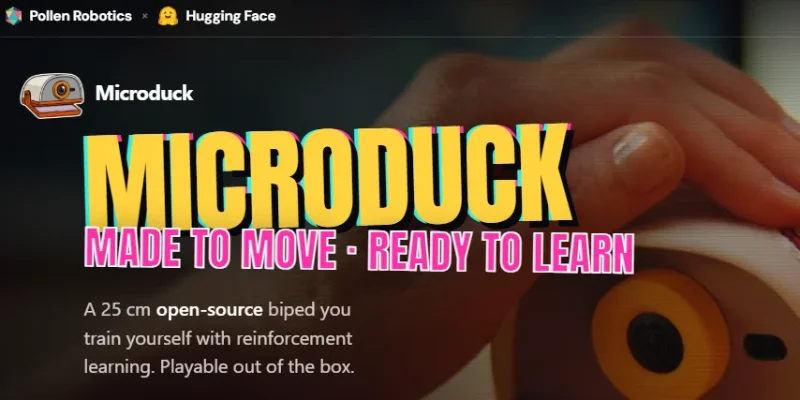
Microduck is a compact, open-source bipedal robot developed by Pollen Robotics, part of Hugging Face. Standing approximately 25 cm tall, it combines programmable movement, onboard sensors, and reinforcement learning to make physical AI experimentation more accessible. Users can control it out of the box and train new behaviours through simulation before deploying them to the real robot.
What Is Microduck?
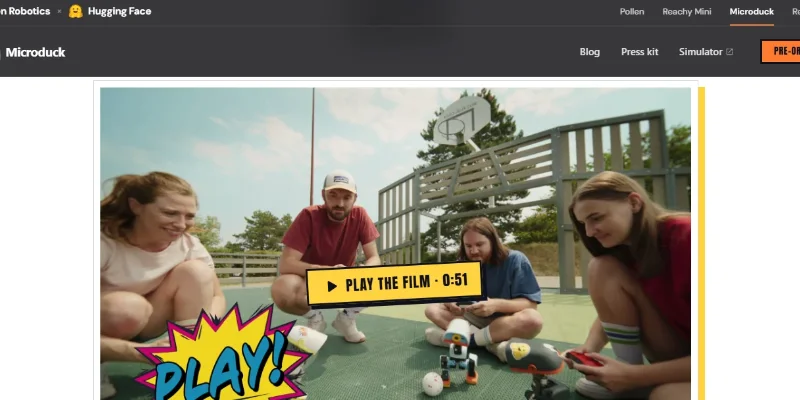
Microduck is a small, duck-inspired robot designed for interactive play, robotics education, and hands-on AI development. It features 15 motors, a camera, LiDAR, two inertial measurement units (IMUs), and an articulated beak that can pick up small objects. Its built-in behaviours include walking, sitting, standing, kicking, grabbing objects, roller-skating with compatible accessories, and recovering from certain falls.
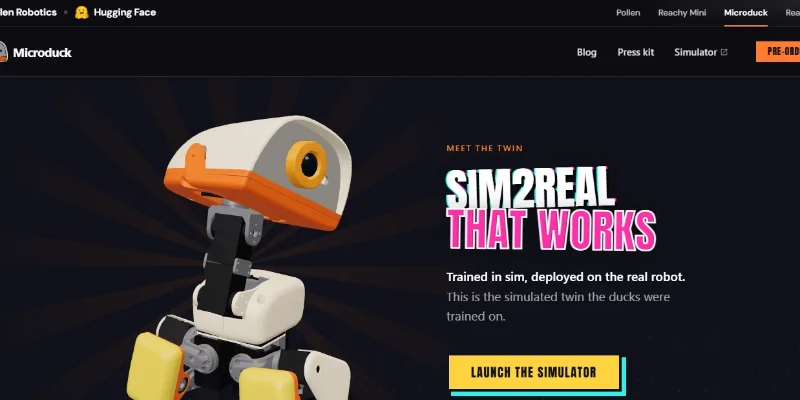
The platform uses reinforcement learning and simulation-to-real (sim-to-real) training. Developers can train and refine behaviours in the MuJoCo physics simulator, then deploy the resulting policies to the physical robot. Its open-source SDK, simulator, and reinforcement-learning tools allow users to inspect, modify, and share new behaviours. \
Microduck is intended for robotics enthusiasts, developers, educators, students, and makers interested in experimenting with AI on physical hardware. The robot includes a game controller for immediate interaction, while optional development and accessory packs provide additional components for experimentation.
Verifiable Stats
-
Developer: Pollen Robotics, part of Hugging Face
-
Robot height: Approximately 25 cm
-
Weight: Approximately 780–800 g
-
Motors: 15
-
Sensors: Camera, LiDAR, and two IMUs
-
Built-in behaviours: Seven advertised trained policies
-
Control loop: 50 Hz
-
Software: Open-source SDK and reinforcement-learning stack under the Apache 2.0 license
-
Simulator: MuJoCo
Screenshots & Demo
Key Features
Core capabilities and functionalities provided by Microduck.
Context-Aware Code Completion & Synthesis
Delivers low-latency inline code completions, multi-token suggestions, and semantic completions customized to the repository context.
Multi-File Codebase Indexing & Exploration
Deeply scans project files, dependency trees, and symbol references to provide comprehensive cross-file edits and refactorings.
Automated Git & Terminal Workflow Automation
Executes shell commands, analyzes test runs, resolves syntax and runtime bugs, and crafts clean commit messages and pull requests.
Architectural Refactoring & Security Audit
Spots security vulnerabilities, dead code paths, and architectural smells, providing one-click semantic fixes and unit tests.
Pros & Cons
Key strengths and potential limitations of Microduck.
What We Like
- Compact and Lightweight Design: Its small, duck-inspired form makes it suitable for desktop experimentation, demonstrations, and hands-on robotics projects.
- AI-Powered Movement: Microduck comes with trained behaviours such as walking, sitting, kicking, grabbing objects, and recovering from certain falls.
- Open-Source Development: Its SDK and reinforcement-learning tools allow developers to inspect, modify, train, and share robot behaviours.
- Simulation-Based Training: MuJoCo integration supports training and testing movement policies in simulation before deploying them to the physical robot.
- Built-In Sensors and Actuators: Fifteen motors, a camera, LiDAR, and two IMUs provide hardware for experimenting with perception, movement, and robotics control.
Where It Falls Short
- Hardware Purchase Required: Users need the physical robot to explore its full real-world capabilities, which creates a higher initial cost than software-only robotics simulators.
- Technical Learning Curve: Reinforcement learning, simulation environments, and robot programming may require prior knowledge of Python, robotics, or machine learning.
- Limited Physical Size: Its compact dimensions and small actuators limit the size of objects it can manipulate and the environments it can navigate.
- Development May Require Additional Setup: Custom behaviours may need software configuration, simulation training, debugging, and hardware testing.
- Availability and Delivery Uncertainty: Pre-order status and targeted delivery dates may change, so buyers should verify current stock, shipping, and delivery information before purchasing.
Use Cases
Discover common workflows and scenarios where Microduck excels.
Robotics Education
Introduce students to robot movement, sensors, actuators, and control systems through hands-on interaction with a physical robot.
Reinforcement Learning Experiments
Train and refine movement policies using reinforcement-learning techniques to explore how robots can learn behaviours through simulation and experimentation.
AI Behaviour Development
Develop and customize robot behaviours by modifying existing policies or experimenting with new control strategies using the available development tools
Simulation-to-Real Robotics
Train and test robot policies in the MuJoCo simulator before deploying suitable behaviours to the physical robot.
Robot Locomotion Research
Experiment with bipedal movement, balance, walking, sitting, and recovery behaviours to understand the challenges of legged robotics.
Sensor Integration Experiments
Explore how camera, LiDAR, and inertial measurement unit (IMU) data can support robot perception, orientation, and movement control.
Object Interaction Research
Experiment with basic object manipulation using the robot's articulated beak and supported grabbing behaviours.
Open-Source Robotics Development
Inspect, modify, and extend available software tools to learn how open-source robotics projects are structured and developed.
Similar AI Tools






Latest from Our Blog
Tips, tutorials and insights about AI tools and how to use them effectively.

ChatGPT for Brand Voice: Can It Sound Like You?

ChatGPT for Marketing: The Complete 2026 Guide

Best AI Tools for Real Estate Agents in 2026: Listings, Leads and Follow-Up
Google Gemini vs ChatGPT: Which AI Assistant Should You Actually Use?
Reviews & Community Ratings
Average rating: 8.5 out of 5 (1 total reviews)
Rate Microduck
Community Reviews (0)