Can AI Read Hackers’ Minds? How It’s Changing Ransomware Negotiations
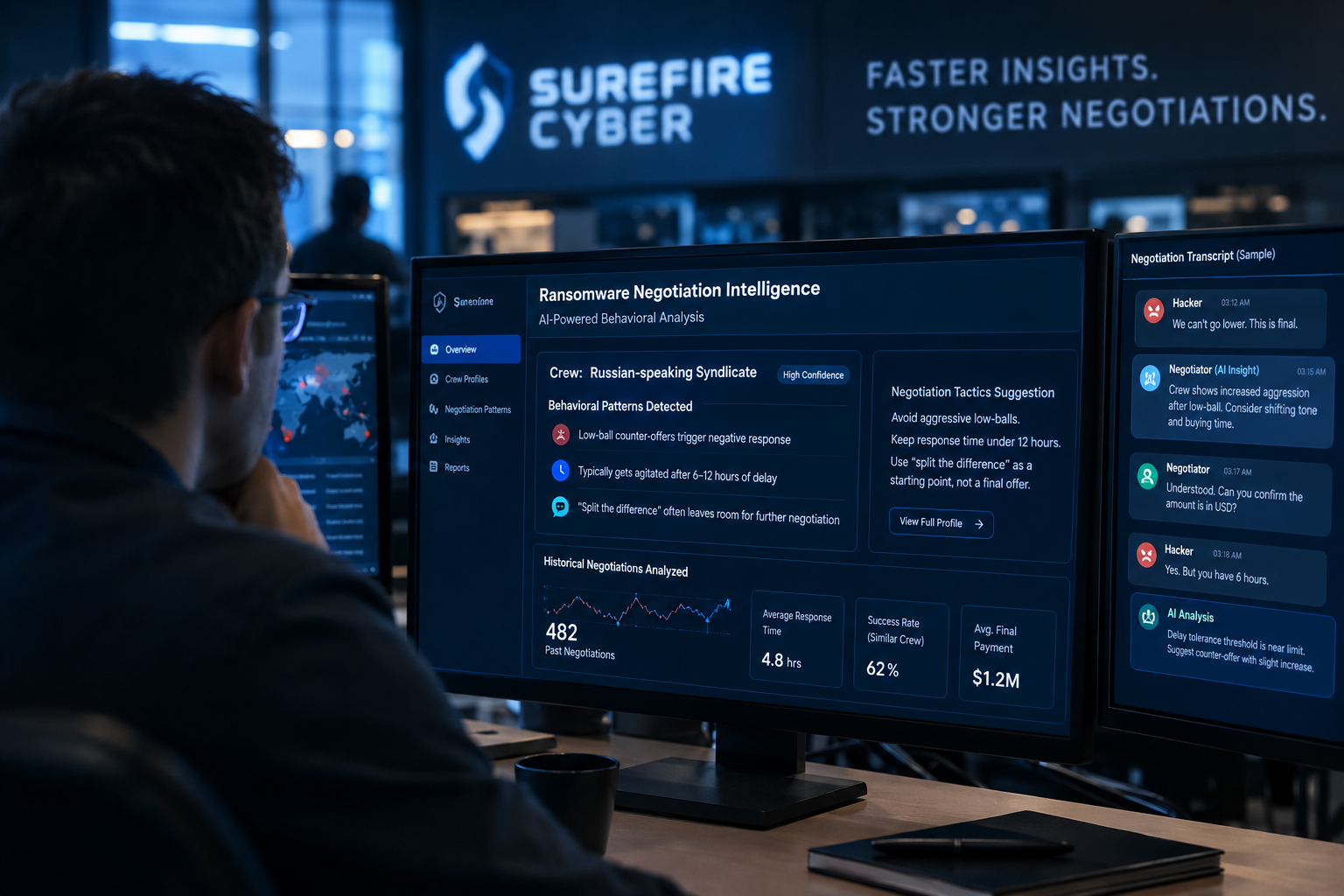
Surefire Cyber has built an internal AI tool that mines hundreds of past ransomware negotiations to detect behavioral tells in specific hacker crews including how Russian-speaking syndicates react to low-ball counter-offers and how long they can be kept waiting. The tool supports human negotiators rather than replacing them, arriving as attackers deploy their own AI chatbots to automate urgency and compress victim thinking time.
Key Takeaways
-
Cybersecurity incident-response firm Surefire Cyber introduced an internal AI tool in 2026 that analyzes hundreds of past ransomware negotiations to help its negotiators tailor tactics based on behavioral patterns from specific cybercrime crews.
-
The AI detects “tells” such as how Russian-speaking syndicates react to low-ball counter-offers, how long they can be kept waiting before they become enraged, and when an offer to “split the difference” still leaves room to bargain.
-
The tool is used internally by human negotiators, not as an autonomous bargaining bot; it compresses the time needed to read an opponent and maintain a credible cover during high-stakes talks.
-
The development comes as ransomware groups themselves deploy AI chatbots to scale negotiations, with Travelers reporting that bots are “automating urgency” by answering instantly at any hour rather than setting prices.
-
Defenders are now training AI to distinguish human operators from bots by spotting uniformly polite messages, instant 24/7 replies, mirrored sentence structures, and abrupt tone shifts after pricing thresholds are crossed.
Surefire Cyber, a US incident-response firm, has deployed an internal AI tool that mines hundreds of past ransomware negotiations to identify the behavioral habits of specific hacker crews — including how Russian-speaking syndicates react to low-ball counter-offers and how long they can be kept waiting before talks sour — giving human negotiators a faster read on their opponents while keeping their negotiating cover intact. The tool, introduced earlier in 2026, marks a shift from purely technical incident response toward data-driven, machine-assisted haggling with cybercriminals.
What Exactly Is the AI Tool Surefire Cyber Built?
The tool is an internal analytics system that ingests historical negotiation transcripts and surfaces patterns about how particular ransomware crews behave under pressure. Rather than replacing negotiators, it gives them a scouting report before and during talks. Bloomberg reported that Surefire “had introduced an AI tool for just that, using it internally to help its staff tailor their tactics based on lessons drawn from past negotiations with various cybercrime crews”.
The core insight is simple: hackers, like everyone else, have habits, and AI is better positioned than any individual human to learn them because it can analyze hundreds of negotiations simultaneously. Joe Tarraf, Surefire’s 41-year-old chief delivery officer and a veteran negotiator, used the tool while bargaining on behalf of a Canadian retailer whose network had been crippled by hackers. He already knew certain things — that the Russian-speaking crew responded badly to low-ball counters, that keeping them waiting too long risked infuriating them, and that when they offered to “split the difference,” there might still be room to bargain. The AI’s contribution is scale: it turns anecdotal experience into a continuously updated behavioral profile.
What Kinds of Behavioral “Tells” Can AI Detect?
The tells fall into timing, tone, and concession patterns. On timing, AI can flag how quickly a crew responds to different types of messages and at what intervals they escalate. On tone, it can detect when a counterpart shifts from rigid, scripted language to more flexible phrasing — a signal that a human operator has taken over from a bot or that the crew is preparing to move. On concessions, it can model whether an offer to “split the difference” is a genuine endpoint or an opening for further haggling, based on how that phrase has functioned in that crew’s prior negotiations.
Security researchers have documented the broader category of tells defenders can probe. Uniformly polite, perfectly structured messages that arrive instantly at any hour suggest automation; consistent mirroring of sentence structures and keyword reuse can indicate a language model rather than a human. A sudden shift in tone or complexity after a pricing threshold often reveals a handoff from bot to human. Defenders can test these boundaries with localized questions — asking a counterpart to confirm the local time, for instance — because confusion or avoidance indicates automation, while oddly precise counters like “17.3% reduction” test adaptability because bots tend to normalize numbers or ignore nuance.
Why Does Maintaining “Cover” Matter in Ransomware Negotiations?
Maintaining cover means preserving the fiction that the person on the other side of the chat is a stressed executive or an authorized representative rather than a professional negotiator running a playbook. If a crew detects that it is dealing with a hired professional — or worse, with an AI-assisted one — it may harden its demands, shorten deadlines, or escalate data-leak threats to regain psychological advantage. AI helps defenders maintain cover because it can suggest responses that are consistent with the victim’s persona while being informed by a much larger dataset of prior exchanges than any individual negotiator could hold in memory.
The same logic explains why predictable machine phrasing can become a liability: if attackers learn a defender’s patterns, the tool that stabilized negotiations becomes a tell in itself. Analysts recommend that AI generate and analyze drafts, but that only authorized human personnel send communications, with legal review and logging of every outbound message.
How Are Attackers Using AI in the Same Negotiation Battles?
Ransomware groups are inserting AI bots into the negotiation loop to triage victims, collect leverage, and scale operations. At Fortra, analysts have observed a growing trend of attackers deploying chatbots for first contact, with humans stepping in only after certain thresholds are met — allowing criminal organizations to manage multiple simultaneous negotiations while reserving human effort for the most profitable cases.
Travelers, the insurer, has confirmed that threat actors use AI chatbots in ransom negotiations, but its cyber-risk director, Matthew Butler, draws a narrower conclusion than the headlines suggest: the bots are not deciding what number to accept. “They’re using bots which have 24/7 availability across all time zones to expedite the initial rounds of communication,” he said, describing the effect as “the automation of urgency and not pricing”. That distinction matters because the victim’s thinking time — the hours needed to stand up an incident-response team, verify backups, and understand what was taken — is exactly what an instant 3 a.m. reply removes.
The broader ecosystem is industrializing. Trend Micro has described ransomware evolving into an AI-powered ecosystem capable of identifying victims, exploiting weaknesses, and negotiating via automated extortion bots. One widely cited 2026 CrowdStrike figure, reported by industry outlets, holds that 34% of ransomware negotiations now involve some level of automated bot interaction, up from roughly 4% in 2024.
What Does This Mean for the Future of Ransomware Negotiation?
The future is hybrid: AI analytics on both sides, with humans retaining authority over price, ethics, and escalation. Academic analysis of AI-mediated crisis negotiation supports exactly this division of labor — automated systems show “considerable promise for managing initial victim communications and intelligence synthesis,” potentially freeing human negotiators to focus on the most complex strategic decisions, while preserving human authority over all strategic and ethical determinations.
For defenders, the practical implication is that negotiation is becoming a data discipline layered on top of a human one. The firms that win will be those that can turn hundreds of prior engagements into behavioral intelligence without becoming so predictable that the intelligence works against them. For attackers, the implication is that bot-driven speed is a weapon, but it also creates fingerprints — and those fingerprints are now training data for the other side.
Key Facts / At-a-Glance
-
Tool builder: Surefire Cyber, a US incident-response and ransomware-negotiation firm.
-
Deployment: Introduced internally in 2026, used by human negotiators — not as an autonomous bargaining bot.
-
Core function: Analyzes hundreds of past negotiations at once to surface behavioral habits of specific cybercrime crews.
-
Example tells: Reaction to low-ball counters; tolerance for delay; whether “split the difference” signals a ceiling or an opening.
-
Case context: Used by negotiator Joe Tarraf on behalf of a Canadian retailer whose network was crippled by hackers.
-
Attacker-side parallel: AI chatbots handle first contact and 24/7 messaging; humans step in at thresholds — “automation of urgency,” per Travelers.
-
Adoption signal: A 2026 CrowdStrike figure, as reported, holds that 34% of ransomware negotiations involve automated bot interaction, up from ~4% in 2024.
Original Source & Attribution
Bloomberg
Read the original announcement and verify the source reporting.
Find the Right AI Tools for Your Next Big Idea
Explore 2,600+ AI tools, compare features, discover powerful solutions and find the right software for your work.