India’s Sovereign AI Push Hits Scale: 38,000 GPUs, 20 Indigenous Models, and a ₹1.27 Lakh Crore Chip Bet
India has operationalised 38,000+ GPUs under the IndiaAI Mission, launched three sovereign foundation models—BharatGen Param2, Sarvam 105B, and Gnani Vachana TTS—and will release its first draft AI regulation consultation paper in November 2026, as MeitY shifts from AI experimentation to deployment at population scale.
Key Takeaways
-
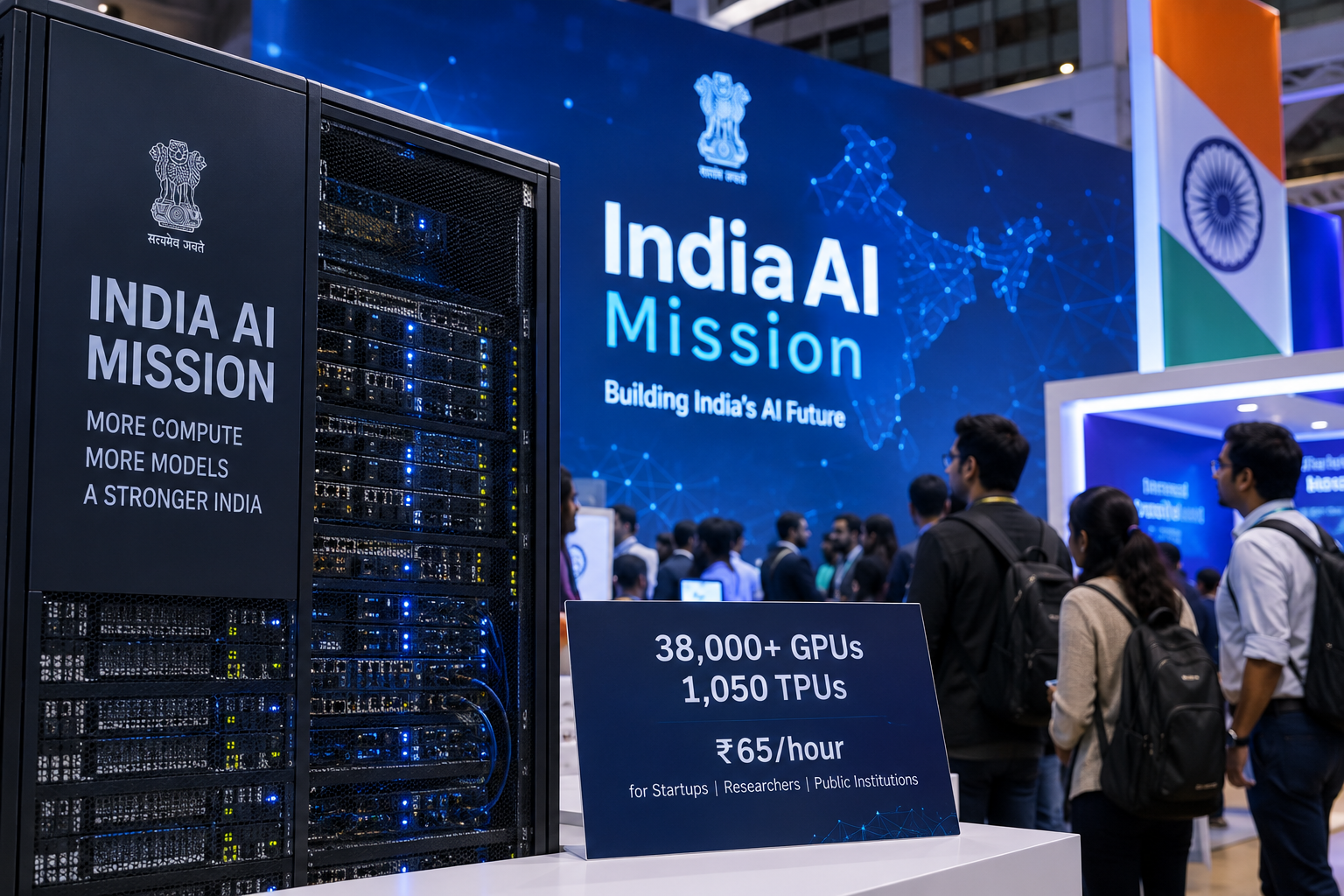
India’s IndiaAI Mission has onboarded more than 38,000 GPUs and 1,050 TPUs onto a shared national compute portal, offered at ₹65 per hour to startups, researchers, and public institutions, with a further 20,000 GPUs announced for addition in 2026.
-
The AIKosh platform aggregates 7,541 datasets and 273 AI models across 20 sectors, giving Indian developers sovereign training data and reusable model resources.
-
BharatGen, India’s first government-owned sovereign large language model initiative, has released the Param-2 text foundation model with 17 billion parameters covering all 22 scheduled Indian languages.
-
Bengaluru startup Sarvam AI has open-sourced 30-billion and 105-billion parameter models trained entirely in India on IndiaAI Mission compute, using a Mixture-of-Experts architecture to lower inference costs.
-
The Union Cabinet approved Semicon 2.0 on July 15, 2026, with a ₹1,27,500 crore outlay to build domestic semiconductor design and manufacturing capacity.
-
IT Minister Ashwini Vaishnaw has said a comprehensive AI regulation consultation paper will be released within a month, shifting India toward formal AI governance while prioritising safety and deepfake mitigation.
India has moved from piloting AI applications to building sovereign infrastructure at national scale. Under the Ministry of Electronics and Information Technology (MeitY), the IndiaAI Mission has assembled 38,000+ GPUs, launched 20 indigenous foundation model proposals, and approved a ₹1,27,500 crore semiconductor programme, positioning the country to reduce structural dependence on foreign AI platforms while anchoring data governance in the Digital Personal Data Protection Act.
What Is India’s Sovereign AI Strategy and Why Does It Matter?
India’s sovereign AI strategy is a deliberate effort to control the compute, data, models, and policy layers of artificial intelligence rather than renting them from foreign platforms. The approach rests on three pillars: subsidised domestic compute through the IndiaAI Mission, government-backed indigenous foundation models trained on Indian languages and datasets, and a semiconductor programme designed to reduce reliance on imported chips.
The strategy matters because AI infrastructure has become a strategic asset. Most cutting-edge AI compute worldwide is rented from a small number of mostly American cloud companies, and for a country building its own AI industry, depending entirely on foreign infrastructure creates a vulnerability in pricing, access, and terms. India’s response is to treat compute as national infrastructure to be built, not merely rented.
How Large Is India’s National AI Compute Pool?
The IndiaAI Compute Portal currently offers more than 38,000 high-end GPUs and 1,050 TPUs at a subsidised rate of ₹65 per hour, roughly one-third of the average global cost. The compute is available to startups, researchers, students, and public institutions through a shared national facility rather than being reserved for a few large players.
On February 17, 2026, Union Minister for Electronics and IT Ashwini Vaishnaw announced that an additional 20,000 GPUs would be added in the coming weeks, expanding capacity beyond the existing 38,000. Separately, MeitY has floated a tender through CDAC for 10,000 more AI compute units, with each cluster required to offer at least 512 AI compute units inside an Indian data centre. The IndiaAI Mission itself is funded at over ₹10,000 crore across five years, with a specific allocation of ₹10,371.92 crore.
What Indigenous Foundation Models Has India Built?
India has backed 20 state-supported indigenous foundation model proposals, and three flagship efforts illustrate the strategy’s breadth. BharatGen is India’s first government-owned sovereign multilingual and multimodal large language model initiative. It is implemented through a consortium led by IIT Bombay with partner institutions including IIIT Hyderabad, IIT Hyderabad, and IIT Madras, supported by ₹235 crore from the National Mission on Interdisciplinary Cyber-Physical Systems and a further ₹1,058 crore outlay through the IndiaAI Mission. Prime Minister Narendra Modi launched BharatGen’s Param-2 text foundation model, a 17-billion-parameter model covering 22 scheduled Indian languages, alongside speech-to-text and text-to-speech models in 12 languages.
Sarvam AI, a Bengaluru-based startup, released 30-billion and 105-billion parameter models trained from scratch entirely in India on compute provided under the IndiaAI Mission, and open-sourced both under the Apache 2.0 licence. The 105-billion parameter model uses a Mixture-of-Experts Transformer backbone that activates only a fraction of parameters per token, keeping inference costs practical while supporting a 128,000-token context window for complex reasoning and agentic tasks.
Gnani.ai launched Vachana TTS, a text-to-speech engine that performs zero-shot voice cloning across 12 Indian languages using under 10 seconds of reference audio, with a Mean Opinion Score of 4.23 and a character error rate below 0.6%. All training, deployment, and hosting for Vachana are done within India, keeping data and models inside Indian data centres.
What Role Does AIKosh Play in Sovereign AI?
AIKosh is India’s shared AI resource platform, designed to give developers ready-to-use datasets and reusable models instead of forcing them to build data pipelines from scratch. As of February 2026, AIKosh brings together 7,541 datasets and 273 AI models spanning 20 sectors on a single national platform. By December 2025, it had recorded over 3.85 lakh visits, 11,000 registered users, and 26,000 downloads.
The platform is a direct response to a structural problem: AI models trained predominantly on Western data often misread Indian linguistic and cultural contexts. AIKosh aims to feed hyper-localised training while bypassing Eurocentric data biases, and it hosts open model weights, including Sarvam’s 30B and 105B releases, for download.
Why Is India Investing ₹1.27 Lakh Crore in Semiconductors?
India approved Semicon 2.0 on July 15, 2026, with a ₹1,27,500 crore outlay because AI sovereignty cannot rest on imported silicon alone. The scheme targets the entire semiconductor value chain, from wafer fabrication to chip design and packaging, and aims to train one lakh technicians and back 200 chip design startups.
The strategic logic is straightforward: even when India runs its own compute pool, the hardware is imported. Semicon 2.0 is designed to change that over time by building domestic design and manufacturing capability, reducing the foreign-supply-chain dependency that persists beneath the sovereign compute layer.
How Is India Approaching AI Regulation and Safety?
India is preparing its first comprehensive AI regulation consultation paper, expected within a month, with AI safety and deepfake mitigation as central priorities. IT Minister Ashwini Vaishnaw said the “time has come for AI regulations” and described deepfakes as a “nuisance which can cause huge problems in society”.
The framework is expected to be techno-legal rather than purely legislative. Vaishnaw has said “AI and technologies cannot be regulated just by having a law. We have to bring a techno-legal solution,” and the government intends to use existing statutes such as the Digital Personal Data Protection Act and the Information Technology Act alongside voluntary commitments. MeitY will also initiate an empanelment process for AI models eligible for government use, allowing approved firms and startups to participate in official tenders.
How Does Project Bhashini Connect AI to Digital Public Infrastructure?
Project Bhashini is a language-first digital public infrastructure initiative under MeitY’s Digital India Corporation that uses AI for real-time voice and text translation to bring government and financial services to non-English-speaking citizens. BHASHINI has recorded over 10 billion cumulative AI inferences and supports 36 Indian languages for text, 23 Indian languages for voice, and 35 international languages.
Its Shrutlekh platform provides real-time speech transcription with simultaneous translation and has been deployed at international civil services programmes, while a website translation plugin enables multilingual access across more than 800 government websites. The model deliberately mirrors the UPI playbook: build shared public infrastructure that any service provider can plug into, rather than leaving language access to private platforms.
Key Facts / At-a-Glance
-
National compute pool: 38,000+ GPUs and 1,050 TPUs, offered at ₹65 per hour; 20,000 additional GPUs announced in February 2026.
-
IndiaAI Mission outlay: ₹10,371.92 crore.
-
AIKosh: 7,541 datasets and 273 AI models across 20 sectors as of February 2026.
-
BharatGen Param-2: 17 billion parameters, 22 scheduled Indian languages; supported by ₹235 crore (NM-ICPS) and ₹1,058 crore (IndiaAI Mission).
-
Sarvam AI: 30B and 105B parameter open-source models, trained entirely in India on IndiaAI compute.
-
Semicon 2.0: ₹1,27,500 crore outlay, approved July 15, 2026.
-
IndiaAI Fellowship 2026: Up to ₹1 lakh for UG students, up to ₹2 lakh for PG students, and ₹70,000–₹80,000 per month for PhD scholars; applications close November 30.
Original Source & Attribution
Ministry of Electronics and IT (MeitY), Government of India; PIB; Medianama
Read the original announcement and verify the source reporting.
Find the Right AI Tools for Your Next Big Idea
Explore 2,600+ AI tools, compare features, discover powerful solutions and find the right software for your work.