Anthropic IPO Filing: Claude Maker Seeks $2 Trillion Valuation on Nasdaq Under Ticker “ANT”
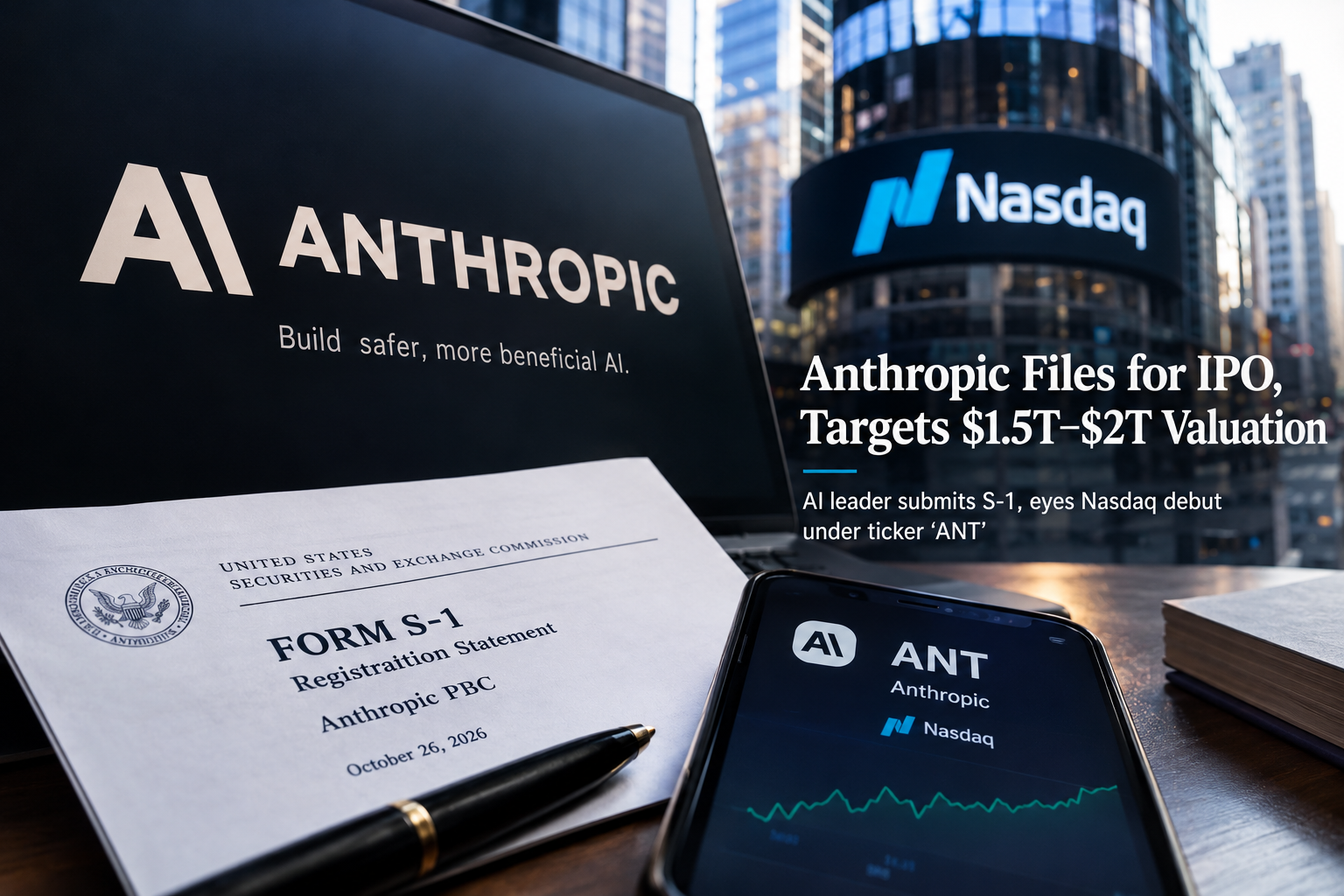
Anthropic filed its Form S-1 with the SEC on October 26, 2026, seeking to list on the Nasdaq Global Select Market under the ticker “ANT.” The filing reveals first-half 2026 revenue of $16.3 billion against a net loss of $80.7 billion—mostly an accounting charge tied to convertible notes—and targets an IPO valuation reportedly between $1.5 trillion and $2 trillion, with a debut expected before Thanksgiving.
Key Takeaways
-
Anthropic publicly filed its Form S-1 registration statement with the U.S. Securities and Exchange Commission (SEC) on October 26, 2026, taking the first formal step toward an initial public offering (IPO) of its Class A common stock.
-
The Claude developer intends to list on the Nasdaq Global Select Market under the ticker symbol “ANT”; the number of shares and price range have not yet been determined.
-
Anthropic reported first-half 2026 revenue of approximately $16.3 billion and a net loss of $80.7 billion, a figure driven primarily by a non-operating accounting charge tied to convertible debt rather than cash operating losses.
-
On an operational basis, Anthropic’s first-half operating loss narrowed to $693 million, and adjusted operating income turned positive at $1.62 billion, reversing a loss of $1.85 billion in the same period of 2025.
-
Reported IPO valuations range from $1.5 trillion to $2 trillion, with a listing targeted for the week of November 16, 2026, or before Thanksgiving, depending on SEC review and market conditions.
-
The filing includes 90 pages of risk factors, with CEO Dario Amodei warning that advanced AI could pose an existential threat to humanity—weeks after he argued in an essay for slowing frontier AI development.
Lede
Anthropic filed its S-1 registration statement with the U.S. Securities and Exchange Commission on October 26, 2026, setting up what could be the largest initial public offering in history and putting the Claude maker ahead of rival OpenAI in reaching public markets. The filing reveals rapid revenue growth to $16.3 billion in the first half of 2026, a headline net loss of $80.7 billion driven largely by accounting charges, and a reported target valuation of $1.5 trillion to $2 trillion on the Nasdaq under the ticker “ANT.”
Body
What Exactly Did Anthropic File—and When Will ANT Stock Trade?
Anthropic filed a registration statement on Form S-1 with the SEC on October 26, 2026, taking the first formal step toward an IPO of its Class A common stock. The filing is not yet effective, meaning shares cannot be sold and offers to buy cannot be accepted until the SEC completes its review and declares the registration effective.
Anthropic intends to list on the Nasdaq Global Select Market under the symbol “ANT.” The number of shares to be offered and the price range have not been determined; those terms will come in a later amendment to the prospectus. Goldman Sachs, Morgan Stanley, and J.P. Morgan are leading a group of 22 underwriters.
No official listing date has been set. Reports indicate a targeted debut before Thanksgiving (November 26, 2026), with the roadshow—the formal marketing of the offering to investors—potentially beginning as early as the week of November 9. Prediction market Polymarket gives an 83.5% probability that trading starts by November 30, though these are traders’ bets, not company guidance.
What Do Anthropic’s Financial Disclosures Reveal?
Anthropic’s revenue is growing at extraordinary speed, but the company remains unprofitable on a net basis. First-half 2026 revenue reached approximately $16.3 billion, a jump of roughly 1,300% from $1.163 billion in the same period of 2025. The six-month figure alone exceeds Anthropic’s full-year 2025 revenue of $4.585 billion.
The headline net loss of $80.7 billion is largely an accounting artifact, not cash burned on operations. Roughly $72.4 billion of that loss stems from convertible notes and SAFEs (simple agreements for future equity) issued to early backers; as Anthropic’s valuation rose, these instruments became costlier liabilities on paper. That one line represents about 90% of the reported net loss.
On an operational basis, the picture is considerably stronger. The operating loss for the first half of 2026 narrowed to $693 million, and adjusted operating income turned positive at $1.62 billion, reversing a loss of $1.85 billion recorded in the corresponding period of 2025. As of September 30, Anthropic counted more than 11,900 enterprise customers generating at least $100,000 in trailing-12-month revenue, with roughly 250 surpassing $10 million. Net revenue retention reached approximately 900%, and trailing-12-month revenue per employee stood above $6.6 million.
By June 30, 2026, Anthropic had raised a cumulative $141.1 billion and held $112.4 billion in cash and equivalents alongside $19.3 billion in short-term investments.
What Valuation Is Anthropic Targeting—and How Does It Compare?
Anthropic was valued at $965 billion by private investors in its Series H round in May 2026, which raised $65 billion. Reported IPO valuations now range from $1.5 trillion to $2 trillion, with Polymarket traders seeing $1.5 trillion to $1.75 trillion as the most likely range at 58% probability.
At $1.5 trillion, Anthropic would rank among the world’s most valuable public companies, alongside Tesla. At the upper end of $2 trillion, it would surpass most of the global economy’s largest listed corporations. The offering could raise as much as $100 billion, according to reports, which would eclipse the record $86 billion raised by SpaceX in its June 2026 IPO—the current benchmark for the largest-ever public offering.
An Anthropic IPO would also put the company ahead of OpenAI in going public, in what is expected to be a pair of blockbuster stock debuts for the rival AI labs. The filing comes weeks after CEO Dario Amodei argued in an essay for slowing the development of the most advanced AI models.
What Risks Does the S-1 Disclose?
The filing contains 90 pages of risk factors, and the standout among them is existential: Anthropic’s own CEO has warned that advanced AI could pose an existential threat to humanity. The prospectus also warns that AI misuse, cyberattacks, the concentration of power, and the behaviour of misaligned autonomous systems could each cause serious harm.
Beyond the philosophical risks, the filing lists practical ones: the company may struggle to retain key staff, navigate regulatory roadblocks, and secure enough compute power to run its AI systems. Anthropic also disclosed an FTC civil investigative demand concerning its consumer business, and it acknowledged heavy reliance on Amazon and Google as both investors and infrastructure partners.
The company’s governance structure is another unusual feature. A single Class F share issued to a “Founder LLC” holds 50.1% of total voting power for general corporate matters, and an independent Long-Term Benefit Trust controls the board. Anthropic states this structure “has no direct public company precedent” and may deprive public stockholders of an opportunity to influence corporate decisions—including a buyout.
What Compute Commitments Has Anthropic Locked In?
Anthropic’s S-1 details massive multi-billion-dollar infrastructure obligations that underpin its model training and serving. The company disclosed locked-in computing commitments to Google Cloud of $111.1 billion through July 2033, to Amazon Web Services of $110.0 billion through April 2036, and to Microsoft Azure of $44.9 billion through May 2033. Additional deals with AMD, SpaceX, Broadcom, and neocloud providers Lambda and Nscale bring the total annual commitment to $45 billion to $66 billion, or $450 billion to $660 billion in liability over the next 10 years.
These commitments are central to the IPO thesis: Anthropic is asking public investors to fund an AI lab whose access to compute is contractually secured for a decade, at a cost that assumes continued hyper-growth in enterprise AI spending.
Key Facts / At-a-Glance
-
Filing date: October 26, 2026 (Form S-1 with the SEC).
-
Ticker and exchange: “ANT” on the Nasdaq Global Select Market.
-
First-half 2026 revenue: $16.3 billion, up roughly 1,300% year over year.
-
Reported net loss: $80.7 billion, of which ~$72.4 billion is a non-cash accounting charge.
-
Operating loss: $693 million; adjusted operating income: $1.62 billion.
-
Target valuation: $1.5 trillion to $2 trillion (reported); prior private valuation: $965 billion (Series H, May 2026).
-
Potential raise: Up to $100 billion, which would exceed SpaceX’s $86 billion June 2026 IPO record.
-
Target listing window: Before Thanksgiving (November 26, 2026), with roadshow possibly starting the week of November 9.
Original Source & Attribution
Associated Press / CBC News / Yahoo Finance / WION
Read the original announcement and verify the source reporting.
Find the Right AI Tools for Your Next Big Idea
Explore 2,600+ AI tools, compare features, discover powerful solutions and find the right software for your work.