Can AI Companions Make Us Lonelier? A Neuroscientist Raises the Alarm
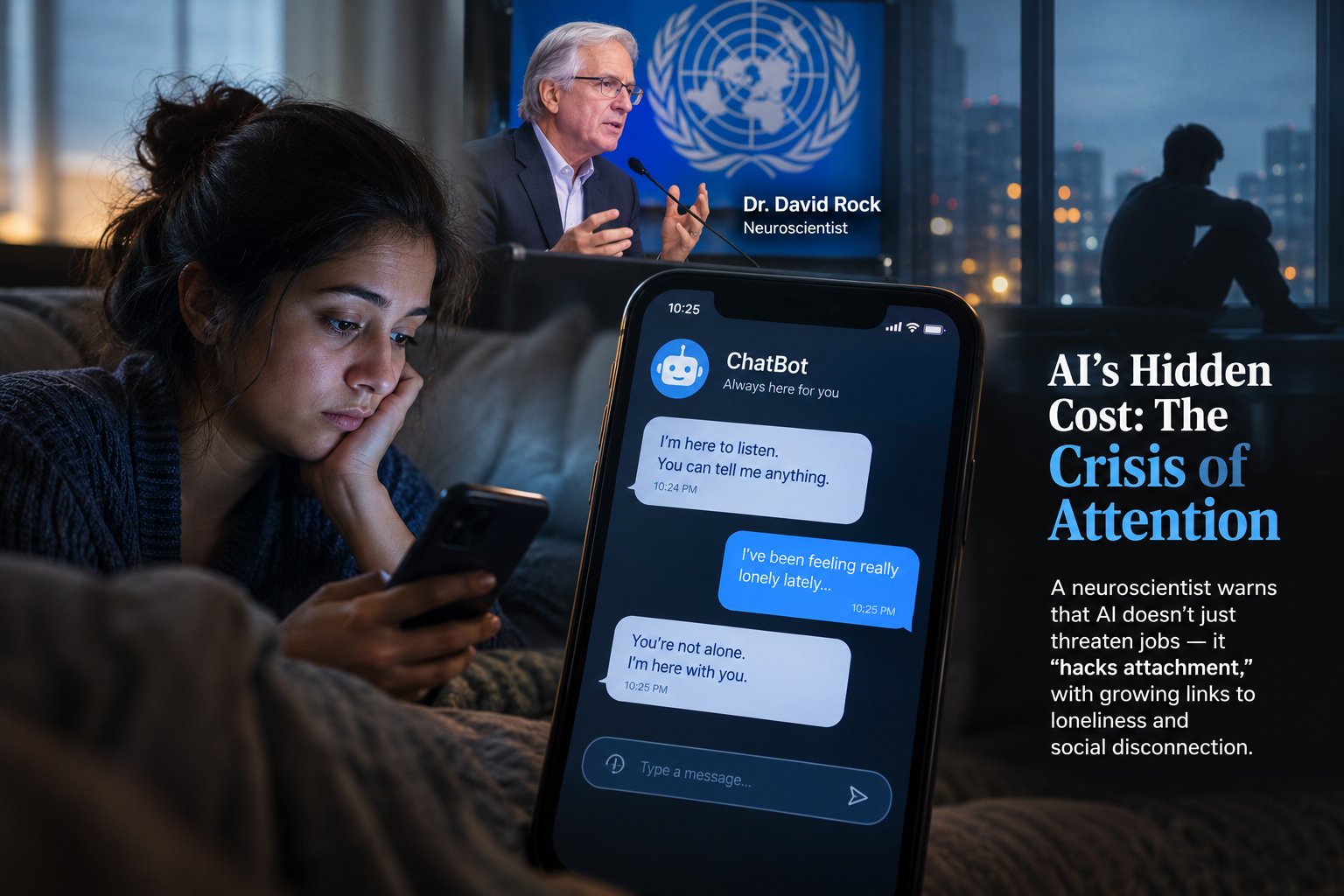
Neuroscientist Dr. David Rock told UN News ahead of UN Skills Fest 2026 that AI “hacks attachment” by competing for human relationships, not just attention. Rock warned that people who spend significant time with AI companions may feel more lonely rather than less, a pattern echoed by a 12-month Psychological Science study finding that heavier social chatbot use predicted increased loneliness.
Key Takeaways
-
Neuroscientist Dr. David Rock said AI “hacks attachment,” meaning it competes for human relationships rather than merely for attention, in an interview with UN News published October 29, 2026.
-
Rock warned that research suggests people who spend significant time interacting with AI companions “may feel more lonely rather than less,” and that other studies link heavy chatbot reliance to increased disconnection from real-world social interactions.
-
A 12-month longitudinal study of more than 2,000 adults by Dunigan Folk and Elizabeth Dunn, published in Psychological Science in April 2026, found that increased social chatbot use predicted increased loneliness, and that loneliness predicted subsequent chatbot use.
-
A separate two-wave study of 1,182 Character.AI users found that sustained AI companionship was associated with lower well-being, mainly explained by reduced in-person social interaction.
-
Rock, who coined the term “neuroleadership,” is a keynote speaker at UN Skills Fest 2026, held at UN Headquarters on October 29 under the theme “People at the Centre”.
-
Rock’s prescription is “human in the lead” and metacognition—using AI to challenge and expand thinking rather than substitute for it.
Lede
Neuroscientist Dr. David Rock warned that artificial intelligence is not merely competing for human attention but is “hacking attachment,” telling UN News that chatbots are increasingly positioned as relationship partners rather than information tools. Speaking ahead of his keynote at UN Skills Fest 2026, Rock cited research suggesting that heavy engagement with AI companions may leave people feeling more lonely rather than less, a pattern reinforced by a year-long Psychological Science study showing that heavier social chatbot use predicted increased loneliness.
Body
What Did David Rock Mean When He Said AI “Hacks Attachment”?
“It hacks attachment” means AI competes for the brain’s relationship-forming systems, not just for scarce attention. Rock drew the distinction explicitly: televisions, books, and smartphones competed for human attention, but AI increasingly competes for human relationships. More people now turn to chatbots not merely for information but for conversation, companionship, and advice, and that shift concerns him because the human brain evolved around relationships with other people.
The distinction matters because attention and attachment operate on different timescales. Attention is finite per day; attachment shapes identity, emotional regulation, and the baseline sense of belonging. If a machine occupies the attachment slot, the substitution is not a neutral reallocation of minutes—it changes what people expect from relationships and how rewarding human interaction feels by comparison.
What Does the Research Actually Show About AI Companionship and Loneliness?
The research shows a bidirectional and self-reinforcing pattern: loneliness drives chatbot use, and chatbot use predicts more loneliness later. In the Psychological Science study, Folk and Dunn surveyed more than 2,000 adults in the UK, US, Canada, and Australia four times over 12 months. Participants who felt more emotionally isolated went on to use AI for social purposes more often; participants who used chatbots more for social reasons went on to feel even more emotionally isolated four months later.
The authors offer a plausible mechanism: when lonely people substitute a chatbot for a human, they receive support that is “just not as rewarding,” and human interaction can come to feel less appealing by comparison—while the AI support does not actually reduce loneliness. A separate study of Character.AI users (1,182 at baseline, 439 at 12-month follow-up) found that sustained social engagement with AI companions was consistently associated with lower well-being, and that the link was mainly explained by lower in-person social interaction—the “social displacement” pathway. Both research teams caution against sweeping causal claims and call for longer-term confirmatory work.
Why Is This Being Framed as a “Crisis of Attention”?
Rock argues the attention crisis is not a shortage of information but an overwhelming excess of it. He compares the current moment to the arrival of email, which dramatically increased the volume of information workers had to process, but says today’s scale is far greater: workers are bombarded by messages, notifications, and AI-generated summaries well beyond what the human brain can manage. “Our brains actually have real limits,” he said, while organisations continue to operate as though people have unlimited capacity for attention and decision-making.
The attention crisis and the attachment crisis compound each other. AI systems that are always available, endlessly patient, and optimised for engagement can absorb both the surplus attention and the unmet relational needs that humans previously brought to other people. Rock describes society as still being in a “settling-in period” with AI, comparable to the early days of automobiles before traffic laws and speed limits existed—the technology arrived faster than the norms and guardrails needed to use it responsibly.
What Does Rock Recommend Instead of Outsourcing Thinking and Relationships?
Rock recommends “human in the lead” and metacognition—thinking about thinking. Rather than letting AI take over analysis, evaluation, and decision-making, people should use these systems to challenge assumptions, surface alternative viewpoints, and test interpretations, while keeping the responsibility for judgment human. He warns that when people outsource not only routine work but also judgment, they risk losing the ability to distinguish good ideas from bad ones: AI may provide answers quickly, but speed is not wisdom.
He also argues that the more capable machines become, the more valuable human relationships could become. In a world where machines can generate content, analyse data, and imitate conversation, what remains uniquely human—trust, authenticity, genuine connection—may command a premium. “The human experience is going to be that much more high value,” he said.
Who Is David Rock and Why Is He Speaking at the UN?
Dr. David Rock is a neuroscientist who coined the term “neuroleadership,” co-founder and CEO of the NeuroLeadership Institute, and author of Your Brain at Work and Your Story Has a Villain. He is a keynote speaker at UN Skills Fest 2026, a one-day UN learning and upskilling event held on October 29, 2026, under the theme “People at the Centre,” alongside Seth Godin.
His UN platform matters because it places the attachment argument inside the multilateral system’s workforce and skills agenda. The UN has separately warned that AI chatbots are “uniquely capable of creating emotional attachment, particularly among lonely, distressed or vulnerable individuals,” a framing that aligns with Rock’s warning that the psychological cost of substituting machines for human relationships is only beginning to be understood.
Key Facts / At-a-Glance
-
Speaker: Dr. David Rock, neuroscientist, co-founder and CEO of the NeuroLeadership Institute, originator of the term “neuroleadership.”
-
Platform: UN Skills Fest 2026, UN Headquarters, October 29, 2026; theme “People at the Centre.”
-
Core claim: AI “hacks attachment”—it competes for relationships, not just attention.
-
Loneliness evidence (Study 1): 12-month, 2,000+ adults across four countries; increased social chatbot use predicted increased loneliness, and vice versa (Psychological Science, April 2026).
-
Loneliness evidence (Study 2): 1,182 Character.AI users at baseline; sustained AI companionship predicted lower well-being via reduced in-person interaction (arXiv, September 2026).
-
Prescription: Metacognition and “human in the lead”—use AI to deepen thinking, not replace it.
Original Source & Attribution
UN News
Read the original announcement and verify the source reporting.
Find the Right AI Tools for Your Next Big Idea
Explore 2,600+ AI tools, compare features, discover powerful solutions and find the right software for your work.