Abacus
By Abacus
Next-generation AI code assistant with deep multi-file repository understanding.
Overview
Summary: Abacus.AI is an AI-powered platform that provides intelligent AI agents, advanced language models, machine learning tools, and workflow automation for professionals and enterprises. Founded in 2019 by Bindu Reddy and Arvind Sundararajan, the San Francisco-based company helps users automate complex tasks, build AI applications, analyze data, generate content, and develop customized AI solutions. Its product ecosystem includes Abacus AI Agent, ChatLLM, Abacus AI Desktop, Abacus AI Studio, and enterprise AI infrastructure.
What is Abacus.AI?
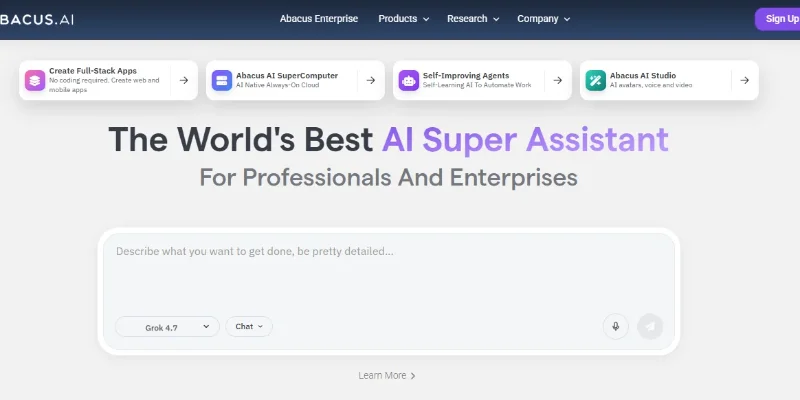
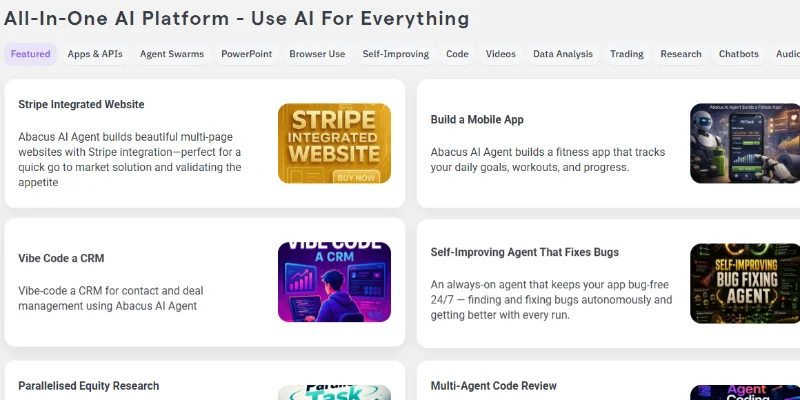
Abacus.AI is an all-in-one AI platform designed to help individuals, developers, businesses, and large organizations use artificial intelligence for everyday work and complex business operations. Its general-purpose AI Agent can perform multi-step tasks such as conducting deep research, writing code, building and hosting full-stack applications, creating presentations, analyzing documents, and automating workflows.
One of its major offerings, Abacus AI Agent (DeepAgent), allows users to describe tasks in natural language. The agent can plan the work, browse the web, execute code, use its own cloud computer, connect with external applications, and deliver completed outputs such as reports, presentations, websites, and applications. Users can also schedule recurring tasks and create automated workflows.
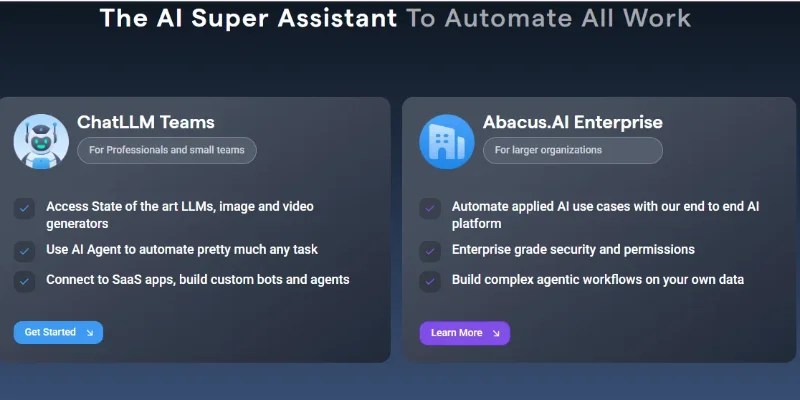
Another major product, ChatLLM, provides access to multiple AI language models through one interface, alongside document analysis, data analysis, image generation, video generation, and AI-powered coding capabilities. Abacus.AI also offers enterprise solutions for organizations that want to build custom AI models, predictive systems, recommendation engines, and autonomous agents using their own business data.
Verifiable Stats:
-
Company: Abacus.AI, Inc.
-
Founded: 2019.
-
Headquarters: San Francisco, California, USA.
-
Founders: Bindu Reddy and Arvind Sundararajan.
-
Product Type: AI Agent Platform, Enterprise AI Platform, and Machine Learning Infrastructure.
-
Main Products: Abacus AI Agent, ChatLLM, Abacus AI Desktop, Abacus AI Studio, and Abacus AI Enterprise.
-
Core Technologies: Generative AI, large language models (LLMs), machine learning, autonomous AI agents, predictive analytics, and workflow automation.
-
AI Model Access: Provides access to models from providers such as OpenAI, Anthropic, Google, and other AI developers.
-
Key Capabilities: Deep research, app development, coding, document analysis, data analysis, presentation creation, image and video generation, and business process automation.
-
Integrations: Supports connections with services such as Google Drive, Slack, SharePoint, Salesforce, and other business applications.
-
Deployment: Cloud-based platform with enterprise deployment options, including deployment in a customer's own cloud.
-
Target Users: Developers, business professionals, startups, small businesses, data scientists, and large enterprises.
-
Company Reach: Abacus.AI reports that 3 million professionals and small businesses use its platform, alongside thousands of enterprises.
Screenshots & Demo
Key Features
Core capabilities and functionalities provided by Abacus.
Context-Aware Code Completion & Synthesis
Delivers low-latency inline code completions, multi-token suggestions, and semantic completions customized to the repository context.
Multi-File Codebase Indexing & Exploration
Deeply scans project files, dependency trees, and symbol references to provide comprehensive cross-file edits and refactorings.
Automated Git & Terminal Workflow Automation
Executes shell commands, analyzes test runs, resolves syntax and runtime bugs, and crafts clean commit messages and pull requests.
Architectural Refactoring & Security Audit
Spots security vulnerabilities, dead code paths, and architectural smells, providing one-click semantic fixes and unit tests.
Native IDE & CLI Integration
Seamlessly operates within developer terminals and mainstream code editors without interrupting daily engineering flow.
Pros & Cons
Key strengths and potential limitations of Abacus.
What We Like
- Powerful Autonomous AI Agents: Abacus.AI allows users to delegate complex, multi-step tasks to AI agents. Its DeepAgent can conduct research, write code, analyze information, and generate completed deliverables with less manual effort.
- Access to Multiple AI Models: Users can work with different AI models through ChatLLM instead of maintaining separate subscriptions or accounts for every model provider. This provides flexibility when choosing models for different tasks.
- All-in-One AI Workspace: The platform combines chat, research, coding, document analysis, data processing, image generation, and other AI capabilities in one environment, reducing the need to switch between multiple tools.
- AI-Powered Application Development: DeepAgent can help users build websites, applications, and software projects from natural-language instructions. This makes application development more accessible to non-technical users and developers.
- Advanced Data Analysis: Abacus.AI provides tools for analyzing datasets, identifying patterns, generating insights, and supporting business decisions through machine learning and AI-powered analytics.
Where It Falls Short
- Complex Feature Set: Abacus.AI offers many products and capabilities, which can make the platform difficult for beginners to navigate. New users may need time to understand its different tools and workflows.
- Usage-Based Costs: Advanced AI models, agent executions, and certain specialized features may consume credits or incur additional charges. Heavy usage can increase the overall cost of using the platform.
- Learning Curve for Advanced Features: Although basic AI chat and natural-language instructions are accessible, building sophisticated workflows, machine learning models, and enterprise applications may require technical knowledge.
- AI Output Requires Verification: Generated code, research summaries, business reports, and data insights may contain errors or incomplete information. Users should review important outputs before using them in production.
- Dependence on External AI Models: Some capabilities rely on third-party AI model providers and connected services. Model availability, performance, and usage costs may vary depending on the selected provider.
Use Cases
Discover common workflows and scenarios where Abacus excels.
AI-Powered Research and Report Generation
Researchers and business professionals can use DeepAgent to conduct detailed research, collect information from different sources, analyze findings, and prepare structured reports. This helps reduce the time required for manual research
Website and Web Application Development
Users can describe their website or application requirements in natural language, and DeepAgent can generate code and build functional web applications. This is useful for startups, entrepreneurs, and developers who want to create digital products faster.
Software Development and Coding
Developers can use Abacus.AI to generate code, debug errors, explain programming concepts, review existing code, and assist with software development projects.
Business Data Analysis
Businesses can upload spreadsheets and datasets to analyze sales performance, customer behavior, revenue trends, and operational metrics. AI-powered analysis can help identify patterns and support business decisions.
Automated Business Workflow Management
Organizations can use AI agents to automate repetitive activities such as information processing, document handling, task coordination, and report preparation. This helps reduce manual administrative work.
Presentation and Slide Creation
Professionals and students can use DeepAgent to create structured presentations from research, documents, or simple instructions. This is useful for business proposals, educational projects, sales pitches, and corporate meetings.
Customer Support Automation
Businesses can build AI-powered agents to answer common customer questions, retrieve relevant information, summarize support requests, and assist customer service teams with routine inquiries.
Document Processing and Summarization
Users can upload PDFs, Word files, reports, and other documents to extract important information, generate summaries, compare content, and answer questions about the uploaded material.
Similar AI Tools
Wordware AI
Next-generation AI code assistant with deep multi-file repository understanding.
Buda
AI-powered coding companion built for high-velocity software engineering.
Zapier Agents
Next-generation AI code assistant with deep multi-file repository understanding.
Leapd
AI-powered coding companion built for high-velocity software engineering.
Stackmint
Context-aware software development platform for rapid engineering workflows.
Springbrand
Build AI Agents That Research, Create, and Automate Tasks
Cloudflare OS
Research, Analyze Data, Build Apps, Create Documents, and Automate Work with Cloudflare
Lindy.ai
AI-powered coding companion built for high-velocity software engineering.
Latest from Our Blog
Tips, tutorials and insights about AI tools and how to use them effectively.
ChatGPT for Brand Voice: Can It Sound Like You?
ChatGPT for Marketing: The Complete 2026 Guide

Best AI Tools for Real Estate Agents in 2026: Listings, Leads and Follow-Up