

HiAPI
By HiAPI
Intelligent developer copilot automating code completion, refactoring, and debugging.
Overview
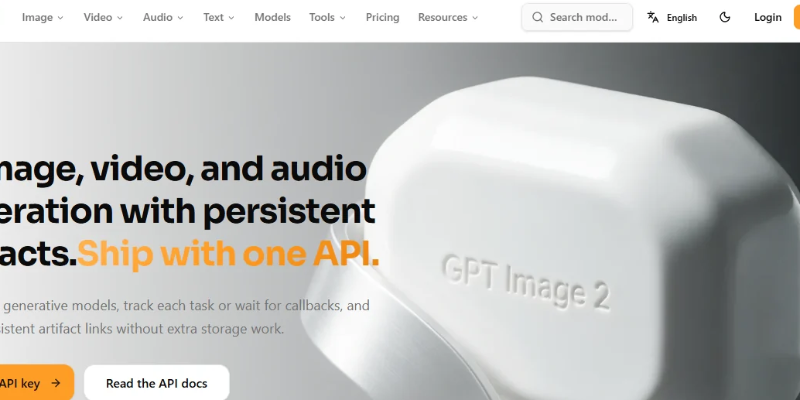
Summary: HiAPI is a developer-focused AI API platform that provides unified access to multiple AI models for image generation, video creation, audio generation, music production, and text processing through a single API key. Instead of integrating separate services from different AI providers, developers can use HiAPI's unified API, shared credit system, and asynchronous task management to build AI-powered applications. It supports models from providers and model families such as OpenAI, Google, ByteDance, Black Forest Labs, MiniMax, and ElevenLabs. The platform also offers Remote MCP, Agent Skills, and API documentation to help developers and AI agents integrate generative AI capabilities into their workflows.
What is HiAPI?
HiAPI is an all-in-one AI API gateway designed to simplify how developers access and integrate generative AI models. It provides a unified interface for connecting to different AI providers without requiring separate API keys, integrations, and billing arrangements for every model. Developers can use one HiAPI API key to access supported image, video, audio, music, and text generation models.
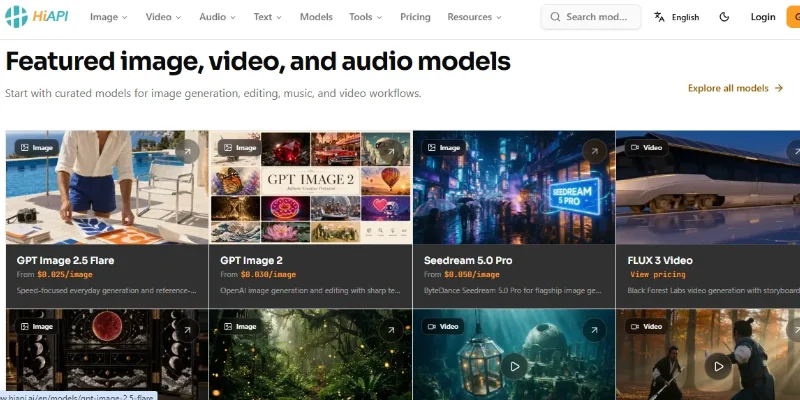
One of its primary capabilities is AI Image Generation and Editing. Users can integrate models such as GPT Image 2, Nano Banana, Seedream, Qwen Image, and FLUX to generate images from text prompts, edit existing images, create product visuals, and produce marketing graphics. Different models provide different capabilities for image quality, reference-based editing, text rendering, and creative control.
HiAPI also provides AI Video Generation APIs that allow developers to create videos from text prompts, reference images, or other supported inputs. Its supported models include Seedance, Veo, Kling, Wan, and FLUX video models. These integrations help developers build video creation applications, automated content production systems, and AI-powered creative workflows.
For audio and music generation, HiAPI connects users with models such as MiniMax Music and ElevenLabs. These capabilities support workflows involving text-to-speech, expressive voice generation, music creation, and audio content production. The platform also provides text-generation endpoints and OpenAI-compatible interfaces for applications that need AI-powered writing, reasoning, coding, and conversational functionality.
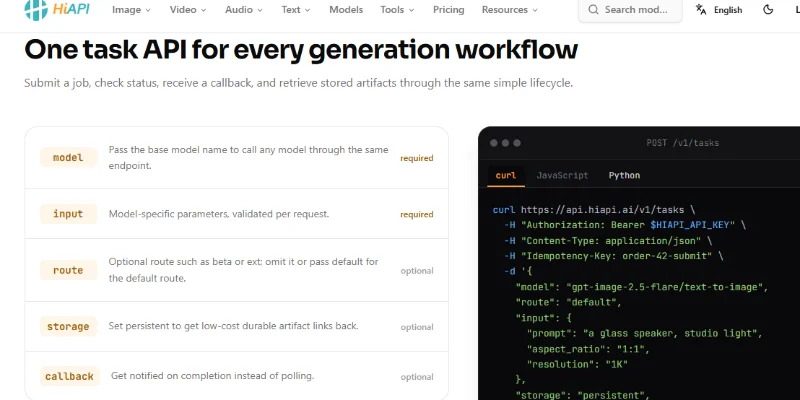
Another important feature is its Unified Async API. Developers can submit a generation task, receive a task ID, check its processing status, and retrieve the generated output. They can also configure callbacks to receive notifications when tasks are completed instead of continuously checking their status. Persistent storage provides durable links to generated images, videos, and other supported outputs.
HiAPI is also designed for AI agents and automation systems. It supports Remote MCP, Agent Skills, and documentation optimized for AI assistants, allowing tools such as Claude, Cursor, Codex, and other compatible agents to discover and use its capabilities. Its pay-as-you-go credit system lets developers pay according to model usage rather than committing to a fixed subscription.
Verifiable Stats & Key Facts
-
Developer: HiAPI (HiAPIAI).
-
Product Name: HiAPI – Unified AI Model API Platform.
-
Product Type: AI API Gateway and Generative AI Integration Platform.
-
Primary Purpose: Provides unified API access to image, video, audio, music, and text-generation models.
-
API Access: One API key and a unified endpoint for supported generation workflows.
-
Supported AI Providers: Includes models from OpenAI, Google, ByteDance, Black Forest Labs, MiniMax, and ElevenLabs.
-
Supported AI Categories: Image generation, image editing, video generation, audio generation, music creation, and text generation.
-
Integration Methods: REST API, OpenAI-compatible endpoints, Remote MCP, and Agent Skills.
-
Task Management: Asynchronous task submission, status tracking, callbacks, and persistent output links.
-
Pricing Model: Pay-as-you-go credits with no mandatory subscription or minimum monthly spend, according to its pricing page.
Screenshots & Demo
Key Features
Core capabilities and functionalities provided by HiAPI.
Context-Aware Code Completion & Synthesis
Delivers low-latency inline code completions, multi-token suggestions, and semantic completions customized to the repository context.
Multi-File Codebase Indexing & Exploration
Deeply scans project files, dependency trees, and symbol references to provide comprehensive cross-file edits and refactorings.
Automated Git & Terminal Workflow Automation
Executes shell commands, analyzes test runs, resolves syntax and runtime bugs, and crafts clean commit messages and pull requests.
Architectural Refactoring & Security Audit
Spots security vulnerabilities, dead code paths, and architectural smells, providing one-click semantic fixes and unit tests.
Pros & Cons
Key strengths and potential limitations of HiAPI.
What We Like
- Unified API Access: Provides access to multiple AI models through a single API key and integration interface, reducing the complexity of managing separate provider connections.
- Wide Range of AI Models: Supports models from providers such as OpenAI, Google, ByteDance, MiniMax, and Black Forest Labs, giving developers flexibility when selecting models for different tasks.
- Multimodal AI Capabilities: Supports image generation, video creation, image editing, music generation, text-to-speech, and text generation through one platform
- Developer-Friendly Integration: Offers REST APIs, OpenAI-compatible endpoints, Remote MCP, and Agent Skills, making it easier to connect AI capabilities with applications and AI agents.
- Flexible Pay-as-You-Go Pricing: Uses a credit-based billing model without requiring a mandatory monthly subscription. Its free starter credits also allow developers to test supported models before purchasing additional credits
Where It Falls Short
- Credit Consumption Can Be High: Video generation and advanced image-generation models can consume credits quickly, particularly when developers run multiple tests or large-scale production workloads.
- Internet Connection Required: API-based generation depends on internet connectivity and the availability of HiAPI's infrastructure and connected model providers.
- Third-Party Model Dependencies: Model availability, processing speed, output quality, and pricing may depend on external AI providers and their respective services.
- Technical Knowledge Required: Developers generally need familiarity with API keys, authentication, request parameters, JSON responses, and asynchronous task management to use the platform effectively.
- Limited Control Over Underlying Models: Although HiAPI provides a unified interface, developers may still encounter different model-specific parameters, output formats, generation limits, and capabilities.
Use Cases
Discover common workflows and scenarios where HiAPI excels.
Building AI-Powered Applications
Integrate multiple generative AI capabilities into web and mobile applications using a unified API. Developers can add image, video, audio, music, and text-generation features without building separate integrations for every provider.
Automating AI Image Generation
Create applications that generate product images, marketing graphics, illustrations, social media visuals, and digital artwork from text prompts or reference images.
Developing AI Video Creation Platforms
Build video-generation applications that transform text prompts and images into short videos using supported models such as Seedance, Veo, and Kling.
Creating AI Music and Audio Applications
Integrate music generation and text-to-speech capabilities into applications for background music, voiceovers, audio storytelling, and other creative audio workflows.
Building AI Writing and Chat Applications
Use supported text-generation models to develop AI chatbots, writing assistants, content generators, coding assistants, and conversational applications.
Connecting AI Agents to Generative Models
Use Remote MCP and Agent Skills to connect compatible AI agents with image, video, audio, and text-generation tools, enabling automated creative and development workflows.
Streamlining SaaS Product Development
Help SaaS developers add AI-powered features to existing products through a unified API, reducing the need to manage multiple provider integrations and billing systems.
Automating Marketing Content Production
Build workflows that generate advertising visuals, promotional videos, product descriptions, social media content, and voiceovers for digital marketing campaigns.
Similar AI Tools

DeepSeek
Open-Source, High-Efficiency AI Models & Advanced Reasoning Engine

Erius Phone
Virtual phone infrastructure for AI agents.

SubmitMyStartup
Find where to submit your startup — MCP server, planner, and API.

Automater
AI coding agent like search all sessions, get alerted when an agent needs you, and track usage across providers, all locally.
Microduck
What If You Could Train Your Own AI Robot at Home?
Papaya
Find What’s Breaking Your AI Agents and Discover How to Fix It.
Diagrid
Build AI Agents That Run Reliably, Recover from Failures, and Scale
AITECH Cloud Network
Intelligent developer copilot automating code completion, refactoring, and debugging.
Latest from Our Blog
Tips, tutorials and insights about AI tools and how to use them effectively.
The 10 Best AI Data Analysis Tools in 2026: ChatGPT, Copilot, and Julius AI Compared

Best AI Tools for Social Media and Thumbnails in 2026
Top AI Tool Directories to Submit To: Complete Guide (2026)
Best Paid AI Tools Worth the Money in 2026: Complete Guide
Reviews & Community Ratings
No reviews yet — be the first to rate and review this tool!
Rate HiAPI
Community Reviews (0)