Rezonant
By Rezonant
Next-generation AI code assistant with deep multi-file repository understanding.
Overview
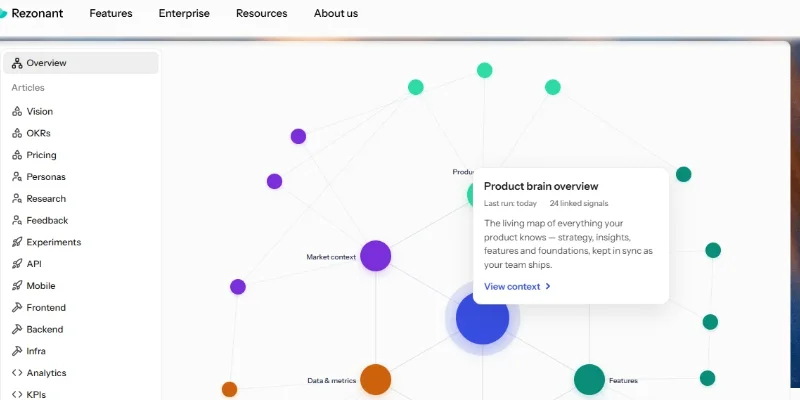
Summary: Rezonant is an AI-powered product management and workflow automation platform designed to help software teams turn product ideas into engineering-ready work. It creates a shared, continuously updated product knowledge layer called the Product Brain, connecting information from tools such as GitHub, Slack, Linear, Notion, Google Workspace, and customer meeting platforms. Its AI agents use this context to generate product requirement documents (PRDs), technical specifications, prototypes, development tasks, and pull requests, while keeping humans involved in important decisions.
What is Rezonant?
Rezonant helps product managers, engineers, and software development teams reduce the gap between product planning and software delivery. Instead of keeping customer feedback, product strategy, technical documentation, and development discussions scattered across different applications, it brings this information together into a centralized Product Brain.
The platform continuously organizes company knowledge and uses it to understand product goals, technical requirements, customer feedback, and existing codebases. Its AI product agent can proactively perform tasks such as researching competitors, identifying duplicate backlog items, preparing PRDs, creating prototypes, writing development tickets, and opening pull requests for review.
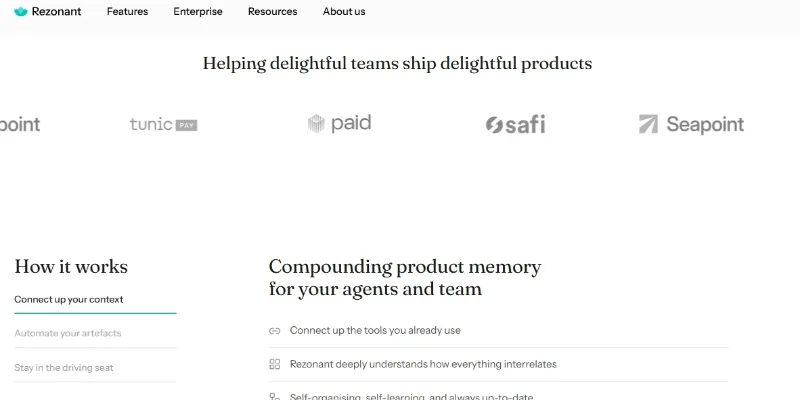
Rezonant also works alongside external coding agents such as Claude Code, Codex, Cursor, Devin, Hermes, and OpenClaw, providing them with shared product context. Teams can review proposed work and approve important decisions through Slack or Microsoft Teams, keeping human oversight in the development process.
Verifiable Stats:
-
Developer: PORTIA AI LTD.
-
Founder & CEO: Emma Burrows.
-
Company Location: London, United Kingdom.
-
Launch Date: May 5, 2026 (Rezonant v1 public launch).
Turn Product Vision Into Engineering-Ready Work+1
-
Platform Type: AI Product Management Platform, AI Agent Platform, and Software Development Automation Tool.
-
Core Technology: Product Brain, autonomous AI agents, and shared product context.
-
Integrations: GitHub, Slack, Linear, Notion, Google Workspace, Granola, Fathom, ClickUp, Amplitude, and Mixpanel.
-
Coding Agent Compatibility: Claude Code, Codex, Cursor, Devin, Hermes, and OpenClaw.
-
Key Features: AI-generated PRDs, technical specifications, prototypes, development tasks, pull requests, backlog analysis, and competitor research.
-
Security: ISO 27001:2022 certified and GDPR compliant. SOC 2 Type II audit is in progress, according to its security page.
Screenshots & Demo

Key Features
Core capabilities and functionalities provided by Rezonant.
Context-Aware Code Completion & Synthesis
Delivers low-latency inline code completions, multi-token suggestions, and semantic completions customized to the repository context.
Multi-File Codebase Indexing & Exploration
Deeply scans project files, dependency trees, and symbol references to provide comprehensive cross-file edits and refactorings.
Automated Git & Terminal Workflow Automation
Executes shell commands, analyzes test runs, resolves syntax and runtime bugs, and crafts clean commit messages and pull requests.
Architectural Refactoring & Security Audit
Spots security vulnerabilities, dead code paths, and architectural smells, providing one-click semantic fixes and unit tests.
Pros & Cons
Key strengths and potential limitations of Rezonant.
What We Like
- Codebase-Aware AI Context: Rezonant connects with GitHub repositories to understand a product's existing structure and technical context. This helps generate more relevant product requirements and engineering tasks.
- Automated PRD Generation: The platform can transform rough ideas, discussions, and product requirements into structured Product Requirement Documents (PRDs), reducing manual documentation work.
- Centralized Product Knowledge: Its Product Brain brings together information from connected tools, helping product managers, designers, and developers work with shared and updated product context.
- Strong Development Tool Integrations: Rezonant connects with tools such as GitHub, Slack, Linear, Jira, and Notion, helping teams coordinate product planning and engineering workflows.
- AI Coding Agent Compatibility: It works alongside coding agents such as Claude Code, Cursor, Codex, and Devin, allowing teams to provide development agents with relevant product specifications and context.
Where It Falls Short
- Relatively New Platform: Rezonant launched publicly in 2026, so it has a shorter track record than established product management platforms. Its long-term reliability and performance at large scale are still developing.
- Credit-Based Usage Limits: AI-generated specifications, research, and agent activities consume credits. Teams with frequent usage may need additional capacity or a paid subscription.
- Learning Curve for New Users: Understanding the Product Brain, connected repositories, AI agents, and automated workflows may take time, especially for teams unfamiliar with AI-powered product management.
- Dependence on Supported Integrations: Rezonant works best when teams use supported tools such as GitHub, Jira, Linear, and Notion. Organizations relying heavily on unsupported or custom-built systems may experience integration limitations.
- AI-Generated Work Requires Review: Automatically generated PRDs, technical specifications, tickets, and code changes may contain inaccuracies or misunderstandings. Product managers and developers should review important outputs before implementation.
Use Cases
Discover common workflows and scenarios where Rezonant excels.
Automated Product Requirement Documents (PRDs)
Product managers can use Rezonant to transform rough product ideas, meeting notes, and business requirements into structured PRDs. This helps teams document product goals, features, user needs, and expected outcomes
Software Development Task Creation
Development teams can convert product requirements into structured engineering tasks. Rezonant helps organize work into actionable tickets that developers can review and implement.
Centralized Product Knowledge Management
Teams can use Product Brain to bring together information from GitHub, Slack, Notion, Linear, and other connected tools. This creates a shared knowledge base for product and engineering teams.
AI-Assisted Technical Documentation
Software engineers and product managers can generate technical specifications using existing product information and codebase context. This helps reduce manual documentation and improve communication between teams.
Product Idea Validation
Startups and product teams can use Rezonant to organize early-stage ideas, research requirements, examine existing product information, and turn concepts into structured development plans.
Codebase-Aware Product Planning
Engineering teams can connect GitHub repositories so Rezonant can use existing codebase information when preparing technical requirements. This helps align proposed features with the current software architecture.
Automated Backlog Management
Product managers can use AI assistance to review development backlogs, identify duplicate tasks, organize pending requests, and improve the clarity of existing tickets.
Customer Feedback Analysis
Businesses can bring customer conversations and feedback into their product knowledge workflow. Rezonant can help identify recurring requests, organize feedback, and translate user needs into potential product improvements.
Similar AI Tools
Wordware AI
Next-generation AI code assistant with deep multi-file repository understanding.
Buda
AI-powered coding companion built for high-velocity software engineering.
Zapier Agents
Next-generation AI code assistant with deep multi-file repository understanding.
Leapd
AI-powered coding companion built for high-velocity software engineering.
Stackmint
Context-aware software development platform for rapid engineering workflows.
Springbrand
Build AI Agents That Research, Create, and Automate Tasks
Cloudflare OS
Research, Analyze Data, Build Apps, Create Documents, and Automate Work with Cloudflare
Lindy.ai
AI-powered coding companion built for high-velocity software engineering.
Latest from Our Blog
Tips, tutorials and insights about AI tools and how to use them effectively.
ChatGPT for Brand Voice: Can It Sound Like You?

ChatGPT for Marketing: The Complete 2026 Guide

Best AI Tools for Real Estate Agents in 2026: Listings, Leads and Follow-Up